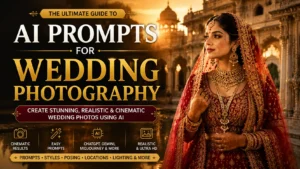
A five-layer prompt framework, ready-to-use prompts, and regional Indian wedding styles for ChatGPT, Gemini, and Midjourney.
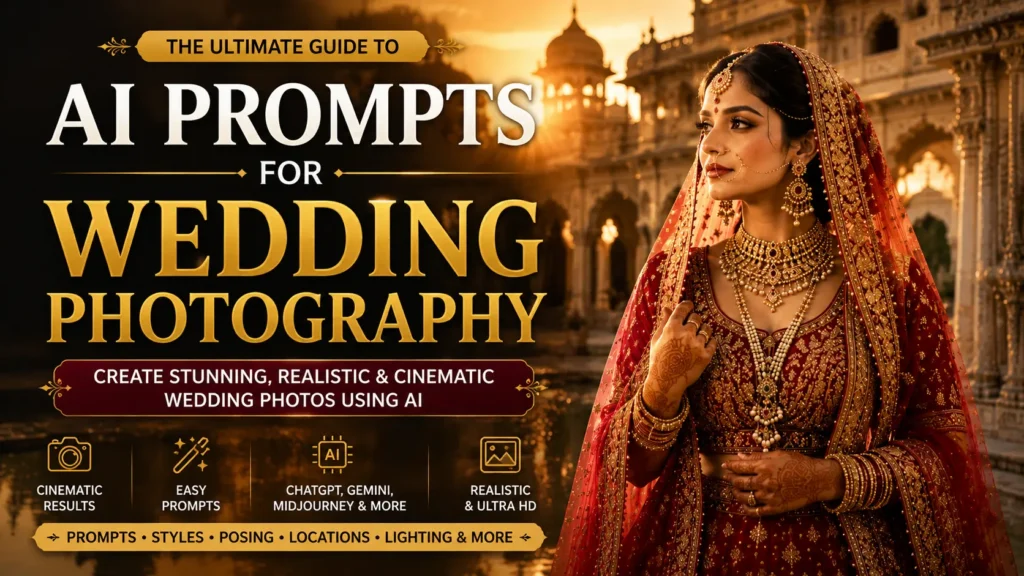
Weddings are expensive to plan and even more expensive to photograph — and long before the actual ceremony, most couples already have a picture in their head of how they want to look. AI image tools have quietly become the fastest way to test that picture before spending a single rupee on a photographer, a venue, or an outfit.
But if you’ve tried this yourself, you already know the problem. Type “Indian wedding photo” into ChatGPT or Gemini and you’ll get a generic bride in a generic red lehenga standing in front of a generic marigold arch — technically pretty, but nothing that looks like your wedding, your skin tone, or your region’s traditions. The AI isn’t the limitation. The prompt is.
This guide gives you a repeatable system — not just a list of prompts to copy blindly — for building AI wedding and bridal photos that actually look like they belong to a real couple, a real ceremony, and a real photography style. We’ll cover dreamy, cinematic, traditional, and standalone bridal-art aesthetics, region-specific detail for Indian weddings, a template you can reuse for any scene you dream up, and the exact settings that stop your results from looking “AI-generated.”
Why Use AI for Wedding Photography Prompts?
Before the framework, it helps to know where this actually fits into wedding planning — because AI wedding photos aren’t meant to replace your photographer.
- Pre-wedding visualization. See how a lehenga colour, a hairstyle, or a venue backdrop will actually look in photos before you commit to any of them.
- Save-the-date and invitation content. Couples are increasingly using AI-generated portraits for digital invites and social announcements, especially for destination or intimate weddings where a full pre-wedding shoot isn’t practical.
- Bridal art for its own sake. Not every AI bridal image needs a groom, a venue, or a ceremony — solo bridal portraits are their own fast-growing category, used for wallpapers, profile art, and standalone social posts (more on this below).
- Content creators and photographers. If you run a wedding photography page or sell presets, AI mockups let you build a mood board or portfolio concept before a real shoot, without needing a paying client first.
- Budget-conscious couples. A professional pre-wedding shoot in India can run anywhere from ₹15,000 to well over ₹1,00,000 depending on the city and photographer. AI prompts won’t replace that, but they let you explore looks for free first.
- Long-distance or destination couples. If your partner or family can’t be physically present for a concept shoot, AI lets you visualize a shared moment using individual reference photos.
None of this replaces a real wedding photographer on the actual day — a real photographer captures things AI cannot: your grandmother’s expression during the kanyadaan, the exact way your hands shook during the vows. AI is a planning and content tool, not a photography substitute, and it’s worth being upfront about that with anyone who sees the images.
Which AI Tool Should You Use?
Not every tool handles wedding prompts the same way. Here’s what to reach for depending on what you’re trying to do:
| Tool | Best for | Why |
|---|---|---|
| ChatGPT Image (GPT-Image) | Preserving your actual face from an uploaded photo | Strongest at keeping facial identity consistent when you upload a reference image and ask for edits or scene changes |
| Gemini (Nano Banana) | Natural language mood and emotional nuance | Understands descriptive, emotional phrasing (“a stolen glance,” “quiet joy”) better than literal keyword strings |
| Midjourney | Cinematic, editorial, painterly wedding scenes | Best raw image quality for dramatic lighting, wide cinematic shots, and stylized colour grading |
| Ideogram | Text-accurate invitation graphics and typography | If you’re generating save-the-date graphics with names or dates on them, Ideogram renders text far more reliably |
If your priority is make the image look like exactly you, start with ChatGPT Image or Gemini and upload a clear, front-facing reference photo. If your priority is make the image look like a magazine spread and you don’t need your exact face, Midjourney generally produces the most cinematic results.
The Five-Layer Wedding Prompt Framework
Every prompt in this guide is built on the same structure we use across our prompt guides on this site — five layers, stacked in order, that take a prompt from vague to professional-grade.
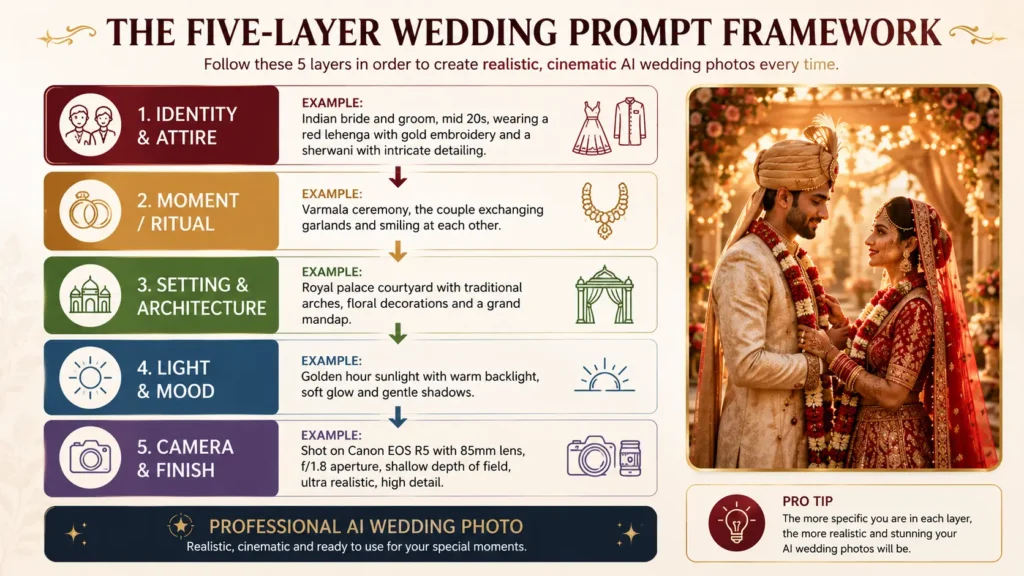
Layer 1 — Identity & Attire Who is in the photo, and exactly what are they wearing? Be specific about fabric, colour, jewellery, and draping style — “red lehenga” produces something generic; “deep maroon silk lehenga with gold zari embroidery and a dupatta draped over one shoulder” gives the AI something to actually render.
Layer 2 — Moment or Ritual What’s happening in the frame? A posed portrait and a candid mid-ritual moment (varmala, mehendi, saat phere) need completely different instructions. Naming the specific ritual also signals the AI to include the correct props and setting automatically.
Layer 3 — Setting & Architecture Where is this taking place? Palace courtyard, banyan tree mandap, beach, rooftop, indoor haveli — the setting should match the ritual and the region. A South Indian temple wedding and a Punjabi Sikh wedding have visually distinct venues, and naming that specificity is what separates a real-looking photo from a stock template.
Layer 4 — Light & Mood This is the single most important layer for realism. Naming a specific light source — “golden hour backlight,” “warm string-light glow,” “soft overcast daylight” — does more to sell photorealism than any other instruction in the prompt.
Layer 5 — Camera & Finish Close every prompt with technical, photographic language: camera body, lens, aperture, depth of field, resolution, and aspect ratio. This is what tells the AI to render a photograph rather than an illustration or a digital painting.
Stack all five layers in order and you’ll consistently get results that look shot, not generated.
Build Your Own: The Reusable Prompt Template
Once you understand the five layers, you don’t need to keep copying prompts word-for-word — you can write your own for any outfit, ritual, or setting you have in mind. Fill in the brackets below:
A photorealistic [portrait / wide shot / close-up] of a [description of person, e.g. "young Indian bride"] wearing
[exact garment, colour, fabric, and jewellery details], [standing / seated / mid-motion] during [specific moment or
ritual, e.g. "the varmala exchange"] at [specific setting, e.g. "a flower-covered mandap under a banyan tree"].
[Lighting description, e.g. "golden hour backlight with soft lens flare"], [mood word, e.g. "warm and intimate"]
atmosphere. [Expression/pose detail]. Natural skin texture, visible pores, no airbrushed or plastic finish. Shot on a
[camera model], [lens focal length]mm lens, f/[aperture], [shallow/deep] depth of field, [aspect ratio] aspect ratio,
ultra-realistic.
Swap the bracketed sections for your own wedding, region, or style, and keep everything else in place — the order of the layers is doing most of the work.
Universal Negative Prompt
Most AI image generators (Midjourney, Stable Diffusion–based tools, and several ChatGPT/Gemini workflows) let you add a negative prompt — a list of things to explicitly avoid. Pasting this alongside any prompt in this guide will fix the majority of “obviously AI” issues in one step:
distorted hands, extra fingers, fused fingers, warped or asymmetrical jewellery, plastic skin, over-smoothed skin
texture, waxy complexion, blurry face, unnatural symmetry, extra limbs, mismatched earrings, floating fabric, warped
mandap or background architecture, text artifacts, watermark, logo, low resolution, cartoon style, illustration,
overexposed highlights, unnatural eye reflections
If your tool doesn’t have a dedicated negative prompt field, add it to the end of your main prompt as: “Avoid: [list].”
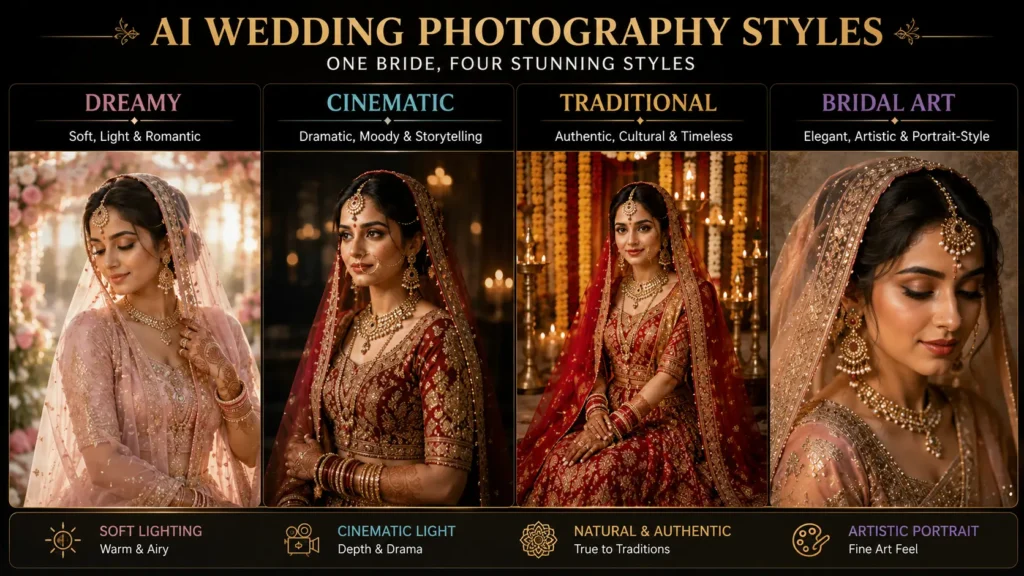
Style Comparison: Which Aesthetic Fits Your Photo?
| Style | Mood | Best Light | Best Tool | Typical Use |
|---|---|---|---|---|
| Dreamy | Soft, romantic, nostalgic | Golden hour, blue hour, hazy backlight | Gemini, ChatGPT Image | Pre-wedding portraits, save-the-dates |
| Cinematic | Dramatic, editorial, high-contrast | Directional light, moody skies, spotlights | Midjourney | Wide venue shots, reception entrances |
| Traditional | Authentic, ritual-accurate, warm | Natural indoor light, fire/diya glow | ChatGPT Image, Gemini | Ceremony recreations, family-facing content |
| Bridal Art | Artistic, solo, expressive | Studio-soft, window light, stylized colour | Midjourney, Gemini | Wallpapers, profile art, standalone social posts |
Dreamy Style Prompts
Dreamy wedding photography leans on soft light, pastel tones, and a slightly hazy, romantic atmosphere. It’s the aesthetic couples reach for when they want images that feel like a memory rather than a document.
1. Golden hour garden portrait
A photorealistic bridal portrait of a young Indian woman in a soft blush pink lehenga with delicate floral embroidery, dupatta
gently blowing in the breeze, standing in a lush garden filled with blurred fairy lights and hanging flowers. Golden hour
sunlight streaming through trees behind her, creating soft lens flare and a warm, hazy glow across the frame. Gentle
smile, eyes slightly downcast, natural skin texture with visible pores, no airbrushed or plastic finish. Shot on a Canon
EOS R5, 85mm lens, f/1.8, shallow depth of field, soft bokeh background, 4:5 vertical aspect ratio, ultra-realistic.
2. Blue hour couple silhouette
A cinematic yet dreamy portrait of an Indian bride and groom standing close together on a rooftop terrace during blue hour,
just after sunset. She wears an ivory and gold lehenga, he wears a matching cream sherwani. The sky behind them is a deep
indigo with the last streaks of orange light on the horizon. Warm string lights are strung overhead, softly out of focus.
Their expressions are calm and intimate, foreheads gently touching. Shot on a Sony A7IV, 50mm lens, f/2, natural skin
texture, soft ambient glow, 3:4 vertical aspect ratio, photorealistic.
3. Mehendi hands close-up
A close-up, photorealistic shot of a bride's hands covered in intricate mehendi (henna) patterns, resting against soft
ivory fabric, delicate gold bangles on her wrists. Soft window light falls across her hands from one side, creating gentle
shadows that highlight the texture of the henna. Warm, muted colour tones, shallow depth of field with the background
softly blurred. Shot on a Nikon Z7, 100mm macro lens, f/2.8, natural skin texture, 1:1 square aspect ratio.
Cinematic Style Prompts
Cinematic wedding photography borrows from film — dramatic lighting, wide compositions, and a colour grade that feels intentional rather than natural. This is the style dominating editorial wedding features this year.
4. Palace courtyard wide shot
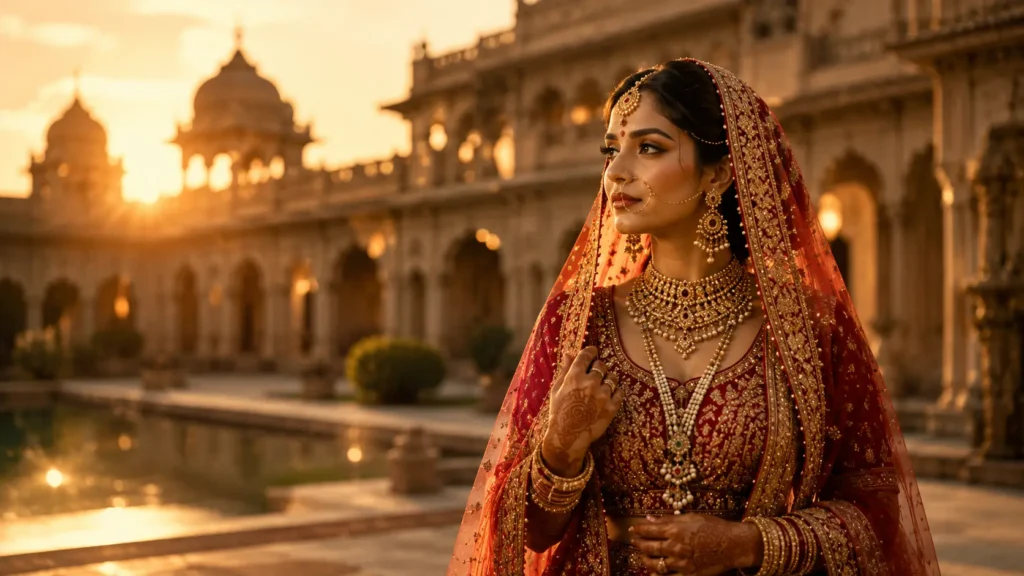
A wide, cinematic photograph of an Indian bride and groom standing in the courtyard of a Rajasthani palace, surrounded by
intricate sandstone jali carvings and tall arched doorways. She wears a deep red and gold bridal lehenga with a long trailing
dupatta, he wears a matching maroon and gold sherwani with a turban. Dramatic late-afternoon light casts long shadows
across the stone floor, warm orange and violet tones in the sky. Wide-angle cinematic composition, rich colour grading,
shot on a RED camera, 35mm lens, deep depth of field, 16:9 aspect ratio.
5. Rain and umbrella moment
A cinematic, photorealistic photograph of an Indian couple sharing a quiet moment under a single umbrella during light
monsoon rain, standing on an old cobblestone street. She wears a deep teal saree with a light shawl, he wears a charcoal
grey kurta. Streetlights glow softly in the background, wet stone reflecting warm and cool light. Moody, film-like colour
grading, visible rain droplets, natural skin texture. Shot on a Sony A1, 35mm f/1.4 lens, shallow depth of field, 3:2
aspect ratio.
6. Dramatic stage entrance
A cinematic, wide-angle photograph of a bride making her entrance at an Indian wedding reception, walking down a flower-
lined aisle under a canopy of hanging marigold and jasmine garlands. She wears a heavily embroidered gold and maroon
lehenga with a statement necklace. Warm spotlight from above catches the fabric's gold threadwork, the background softly
blurred with rows of blurred guests. Rich, saturated colour grading, dramatic contrast, shot on a Canon R5, 24-70mm lens
at 50mm, f/2.2, 4:5 vertical aspect ratio.
AI Bridal Art: Solo Portraits That Aren’t Wedding Scenes
Not every bridal image needs a groom, a mandap, or a ceremony attached to it. “Bridal AI art” has become its own search category — solo, artistic, editorial images of a bride that work as standalone content: profile pictures, phone wallpapers, Pinterest boards, or a getting-ready reel cover. The brief here is different from a wedding scene prompt — the focus is entirely on the bride as the subject, with styling and light doing the storytelling instead of a ritual or setting.
7. Getting-ready candid
A documentary-style, photorealistic getting-ready portrait of an Indian bride seated at a vanity, adjusting her earring in
a mirror's reflection, half-done makeup, a silk robe over her shoulders, bridal jewellery laid out on the table in front of
her. Soft, warm morning window light from one side, calm and quiet mood, candid unposed expression. Shot on a Canon R6,
50mm lens, f/2, natural skin texture, light film grain, 4:5 vertical aspect ratio.
8. Editorial veil-and-fabric close-up
An editorial, photorealistic close-up portrait of an Indian bride, dupatta draped loosely over her head and one side of her
face, soft focus on delicate jewellery and fine embroidery details, eyes looking just past the camera. Dramatic single-
source studio lighting from the side, deep shadows on one half of the frame, rich jewel-toned background. Shot on a Sony
A7R V, 85mm lens, f/1.4, ultra-shallow depth of field, natural skin texture, 4:5 vertical aspect ratio, high-fashion mood.
9. Watercolour-style bridal art for stationery
A soft, painterly watercolour-style illustration of an Indian bride in three-quarter profile, wearing a red and gold
lehenga with fine detailing, holding a small bouquet of marigold and jasmine. Delicate, hand-painted texture with soft
bleeding edges, ivory and dusty-rose colour palette, generous negative space around the figure suitable for adding names
or a date. Elegant, minimal, suitable for wedding stationery and invitation covers. 1:1 square aspect ratio.
Bridal art prompts work well on Midjourney or Gemini even without a face-preservation instruction, since the goal is usually artistic and stylized rather than a literal likeness — though the face-preservation steps below still apply if you want your own face in the result.
Traditional Style Prompts, By Region
Generic “Indian wedding” prompts are the biggest reason AI wedding photos look fake — Indian weddings are not one aesthetic, they’re dozens of distinct regional traditions, each with different attire, rituals, and colour palettes. Naming the region is what makes these prompts work.
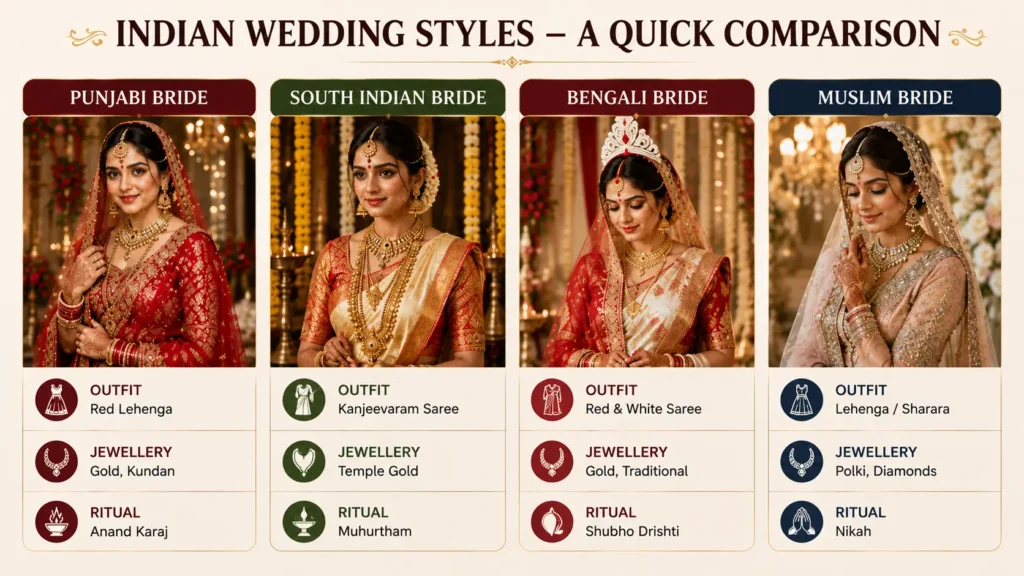
10. Punjabi Sikh wedding — Anand Karaj
A photorealistic photograph of a Punjabi Sikh bride and groom during the Anand Karaj ceremony inside a gurdwara, seated
cross-legged on the floor in front of the Guru Granth Sahib, both with heads covered — she in a bright red and gold chooda
(bangles) visible on her wrists, wearing a heavily embroidered red salwar or lehenga with a kalgi-style dupatta; he in a
cream sherwani with a pink or saffron turban. Soft, warm indoor lighting from overhead fixtures, genuine expressions of
devotion. Shot on a Nikon Z9, 50mm lens, f/2, natural skin texture, warm colour tones, 4:5 aspect ratio, documentary style.
11. South Indian Tamil/Telugu wedding — Muhurtham
A photorealistic photograph of a South Indian bride and groom during the muhurtham (auspicious moment) under a traditional
flower-decorated mandapam, seated with a sacred fire (homam) in front of them. She wears a rich Kanjeevaram silk saree in
deep maroon or mustard with gold zari border, temple jewellery, and jasmine flowers woven into her hair; he wears a cream
and gold veshti (dhoti) with an angavastram. Soft natural daylight filtering through the mandapam's floral canopy, gentle
smoke from the fire adding atmosphere. Shot on a Sony A7R V, 35mm lens, f/2.8, warm natural tones, 3:4 aspect ratio.
12. Bengali wedding — Bor Boron and Shubho Drishti
A photorealistic photograph of a Bengali bride during the Shubho Drishti moment, seated on a decorated pidi (wooden stool)
being lifted by her brothers, her face partially covered by betel leaves that she is about to lower, wearing a red and
white Benarasi saree, elaborate white and red shell jewellery (shakha pola), and a mukut (headpiece). Warm indoor lighting
with string lights and marigold decorations softly blurred behind her. Genuine, emotional expression. Shot on a Canon R6,
85mm lens, f/2, shallow depth of field, natural skin texture, 4:5 aspect ratio, documentary realism.
13. Maharashtrian or Gujarati wedding — Mangalashtak
A photorealistic photograph of a Maharashtrian bride and groom during the Mangalashtak ceremony, a cloth (antarpat) held
between them by priests, rice grains mid-air being showered by guests around them. She wears a traditional nauvari saree
in green or yellow with a nath (nose ring) and mundavalya (pearl strings) on her forehead; he wears a cream dhoti-kurta
with a traditional pheta (turban). Bright, natural daylight, joyful candid energy, guests softly blurred in the
background. Shot on a Fujifilm GFX100, 50mm lens, f/2.8, natural skin texture, 3:4 aspect ratio.
14. Kerala Syrian Christian wedding
A photorealistic photograph of a Kerala Syrian Christian bride and groom just after their church ceremony, standing on the
steps of a whitewashed church with wooden accents. She wears an elegant off-white and gold-bordered kasavu saree with a
veil, gold temple jewellery including a traditional necklace (mullamottu mala); he wears a cream and gold set-mundu with a
jacket. Soft, bright midday coastal light, palm trees softly blurred in the background. Warm, dignified expressions. Shot
on a Nikon Z8, 50mm lens, f/2.5, natural skin texture, 4:5 aspect ratio, documentary style.
15. Muslim Nikah ceremony
A photorealistic photograph of a bride and groom moments after their Nikah ceremony, seated on a decorated stage with
floral backdrop and soft draped fabric. She wears an emerald green and gold sharara or lehenga with a dupatta covering her
head, delicate gold jhumar (hair jewellery) framing her face, intricate mehendi visible on her hands; he wears a matching
sherwani in ivory and gold. Warm, soft indoor lighting, joyful and serene expressions, rose petals softly scattered in the
foreground. Shot on a Canon R5, 85mm lens, f/2, shallow depth of field, natural skin texture, 4:5 aspect ratio.
16. Rajasthani Rajput wedding
A photorealistic photograph of a Rajasthani Rajput bride and groom during the Palla Dena ritual, standing in the courtyard
of a sandstone haveli. She wears a vivid red and gold Rajasthani lehenga with a Poshak-style border, heavy gold jewellery
including a borla (forehead ornament) and rakhdi; he wears a bright pink or saffron safa (turban) with a cream achkan.
Warm late-afternoon desert light, ochre and terracotta tones in the architecture behind them, sense of scale and grandeur.
Shot on a Nikon Z9, 35mm lens, f/4, deep depth of field, warm colour grading, 16:9 aspect ratio.
More Indian Wedding Traditions at a Glance
These traditions are searched often enough to be worth covering, even without a full prompt each. Use the Reusable Prompt Template above and drop in these details for Layers 1 and 2:
| Tradition | Key Attire | Signature Ritual | Colour Palette |
|---|---|---|---|
| Kashmiri Pandit | Pheran with tilla embroidery, dejhoor (ear ornament) | Devgon and Kanyadaan | Deep red, gold, saffron |
| Assamese | Mekhela chador in Assam silk | Juron and Nuoni | Ivory, gold, red border |
| Parsi | White or pastel gara saree with hand embroidery | Madhavsaro and Achoo Michoo | Ivory, pastel pink, silver |
| Goan Catholic | White lace wedding gown, veil | Church ceremony and Ros ceremony | White, ivory, soft gold |
| Marwari | Heavy gota-patti lehenga, borla | Bindori and Toran | Red, maroon, gold |
Getting Your Actual Face Into the Photo
Most people don’t want a photo of “a bride” — they want a photo of themselves. Here’s how to do that properly with ChatGPT Image or Gemini:
- Upload a clear, well-lit, front-facing reference photo. Avoid group photos, sunglasses, or extreme angles — the AI needs an unobstructed view of your face to preserve it accurately.
- Explicitly instruct the model to preserve facial identity. Add a line like: “Use the uploaded photo strictly for facial identity. Keep face shape, eyes, nose, lips, and skin tone completely unchanged. Do not alter age or expression.”
- Separate the face instruction from the scene instruction. Describe the outfit, setting, and lighting as their own paragraph, so the model doesn’t try to “reinterpret” your face while generating the scene.
- Generate in batches, not one at a time. If you need several consistent images (for an invitation set, for example), reuse the same reference photo and the same identity instruction across every prompt, only changing the scene details.
- Expect to regenerate. Even with a strong identity instruction, the first result is rarely perfect. Regenerating two or three times with the same prompt usually produces one result close enough to refine further.
Common Mistakes That Make AI Wedding Photos Look Fake
- Being vague about attire. “Traditional Indian outfit” gives the AI too much room to guess. Name the exact garment, colour, and fabric.
- Skipping the negative prompt. Use the universal negative prompt above — it alone fixes most of the “obviously AI” look.
- Overusing “8K” and “hyper-realistic” as the only style cues. These words don’t do much on their own — the lighting and camera details in Layers 4 and 5 do the actual work.
- Mixing regional details. A Kanjeevaram saree with a Punjabi kalgi and a Bengali shakha pola in the same image is a common AI hallucination when prompts are too generic. Stick to one region’s details per prompt.
- Forgetting aspect ratio. Wedding photos are almost always shot vertically (4:5 or 3:4) for portraits and horizontally (16:9) for wide venue shots. Leaving this out often produces awkward, generic square crops.
Looking to refine your prompts further? Check out our ChatGPT Image Prompts for Realistic Portraits for headshot-level detail, or browse our AI Landscape Photography Prompts – The Framework for Cinematic Results guide if you’re planning outdoor venue shots. For ready-to-use prompt packs including all the styles covered here, visit our Gumroad store.
Frequently Asked Questions
1. Can I use my own photo to generate an AI wedding portrait?
Yes, ChatGPT Image and Gemini both support uploading a reference photo and generating a new scene around your face. Always use your own photo, or a photo you have permission to use — never upload someone else’s photo without consent.
2. Which AI tool gives the most realistic Indian wedding photos?
For preserving your actual face, ChatGPT Image and Gemini (Nano Banana) currently perform best. For cinematic quality where face-matching isn’t the priority, Midjourney tends to produce the most polished, editorial-looking results.
3. Can AI wedding photos replace a real wedding photographer?
No, and they aren’t meant to. AI is best used for pre-wedding visualization, invitation content, and creative concepts. A real photographer captures the unscripted, once-only moments of your actual wedding day that no prompt can recreate — and increasingly, couples are asking photographers directly where they draw the line on using AI in their workflow, which is a good sign of how seriously people are now thinking about this.
4. Is it okay or appropriate to use AI-generated bridal photos publicly?
It’s increasingly common and generally considered fine, as long as you’re transparent about it when it matters — for instance, avoid presenting an AI image as an actual photo from your wedding day. Using AI bridal art for save-the-dates, social posts, or personal content is widely accepted; just don’t pass it off as documentary photography.
5. How do I fix distorted hands or jewellery in my AI wedding photo?
This is one of the most common issues with bridal and couple portraits, since hands and layered jewellery are difficult for most models to render accurately. Add the universal negative prompt above, generate a close-up-only version of just the hands if needed, and regenerate 2–3 times — accurate hands often take a few attempts even with a good prompt.
6. Can I combine two individual photos into one AI couple portrait?
Yes, several tools now support uploading two separate reference photos and merging them into a single scene with matched lighting and scale. When you do this, prompt for both identities to be preserved separately, and describe the interaction between them (their pose, where they’re looking) rather than leaving it to the AI to decide.
7. Do these prompts work for pre-wedding shoots outside India?
Yes — the Five-Layer Framework works for any wedding style. Simply replace the regional attire and ritual details in Layers 1 and 2 with the aesthetic you’re going for, and keep the lighting and camera instructions in Layers 4 and 5 the same.
8. Is AI wedding photography actually becoming a real trend, or is this a passing fad?
Reported usage of AI tools in wedding planning has grown significantly over the past year, and wedding photographers themselves are increasingly incorporating AI into parts of their workflow, like culling and sorting images. Full AI-generated photography hasn’t replaced real wedding photography, and industry sentiment suggests it isn’t trying to — the tools are used alongside a real photographer, not instead of one.