Copy-ready prompts for sarees, kimono, hanbok, qipao, Ankara, kaftan, and dirndl — built on a five-layer framework.
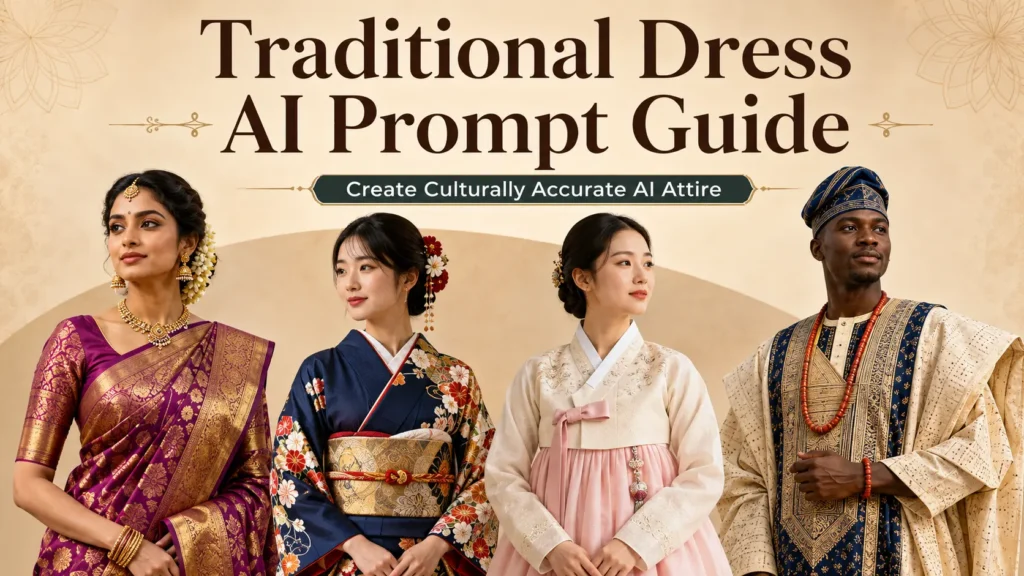
A traditional dress AI prompt only works when it names an actual garment instead of a country. “Traditional Indian dress” or “African traditional dress” leaves an AI model to guess at a whole continent’s worth of textile history, and it tends to land somewhere generic — a costume-like blend rather than a specific, recognizable garment. Name the actual garment, the fabric, and the craft technique instead, and the result changes considerably.
This guide breaks that process into a repeatable structure, then applies it across seven textile traditions with real garment names, not geography labels.
How to use this guide: every tradition below gives you a weak prompt (what most people write), an improved prompt (what to use instead), and an occasion variation. The improved and variation prompts are boxed and ready to copy directly into Gemini, ChatGPT, Midjourney, or Ideogram.
Universal template — start here if you’re building your own:
[Garment name] in [fabric] with [specific craft technique/pattern],
styled with [jewelry/hair/accessories],
set in [location appropriate to the tradition], [lighting description],
[lens/camera detail], photorealistic.
Fill in each bracket with something specific rather than a general adjective, and you already have a workable prompt for any tradition covered below.
Why specificity changes the output
Image models generate by pattern-matching against everything they’ve seen labeled with the words in your prompt. “Traditional dress” is a label attached to an enormous, mixed range of images — festival photography, film costuming, stock photos, museum pieces — so the model has to average across all of it. That average is rarely a specific, correct garment.
“Bandhani-print lehenga with gota patti border” is a much narrower label. Fewer images match it, but the ones that do are far more consistent with each other, which gives the model a clearer target. This is the entire logic behind every prompt formula in this guide: narrow the label, and the output gets more specific along with it.
The Five-Layer Framework
This is the same structural approach used across our prompt guides, adapted for cultural attire.
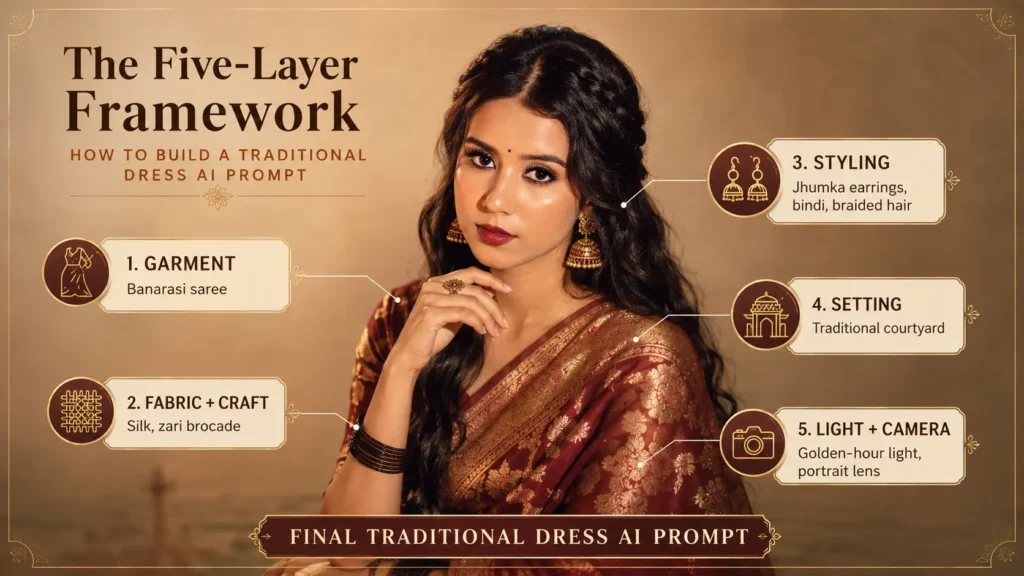
| Layer | What it controls | Example |
|---|---|---|
| 1. Cultural Anchor | The exact garment name | Banarasi saree, furisode kimono, hanbok, agbada |
| 2. Fabric & Craft Detail | The technique that defines it | zardozi embroidery, shibori dyeing, Ankara wax print, ikat |
| 3. Styling | Jewelry, hair, headwear | jhumka earrings, kanzashi ornament, gele headwrap |
| 4. Setting & Context | A backdrop appropriate to the tradition | temple courtyard, hanok rooftops, highland mist |
| 5. Light & Camera | Lens, lighting, texture cues | 85mm lens, golden hour, visible silk sheen |
Using all five layers tends to produce a more specific, more consistent result than using two or three. The formulas below apply this structure to real garments.
Prompt formulas by tradition Attire
Test these in Gemini (Nano Banana Pro), ChatGPT, Midjourney, or Ideogram — the underlying structure holds across tools, though individual platforms vary in how literally they follow long prompts.
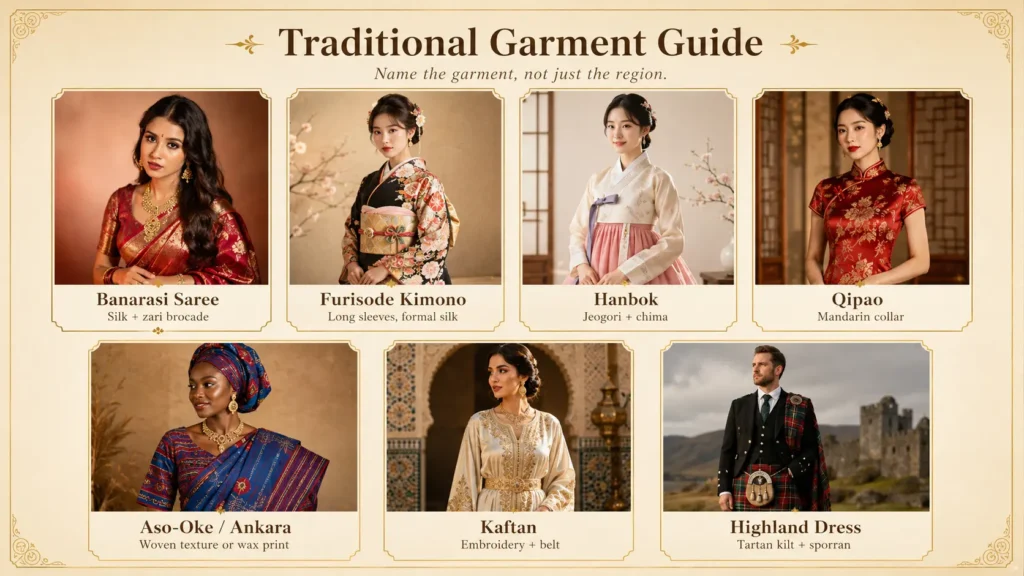
1. Indian sarees and lehengas
India’s textile traditions vary enormously by region, and “Indian traditional dress” collapses dozens of distinct weaves into one vague label. Four worth knowing by name:
- Banarasi — silk from Varanasi, woven with gold or silver zari thread and Mughal-influenced floral motifs. Worn for weddings and formal occasions across India, not tied to one region.
- Kanjeevaram (Kanchipuram) — heavy silk from Tamil Nadu, known for a contrasting woven border and substantial drape. A South Indian bridal staple.
- Bandhani — a Rajasthan and Gujarat tie-dye technique producing small, dense dot patterns in saturated colors. Worn for festivals like Navratri as much as weddings.
- Sambalpuri — an Odisha ikat technique where the yarn is tie-dyed before weaving, producing motifs like the conch (shankha) and wheel (chakra) woven into the fabric rather than printed on top.
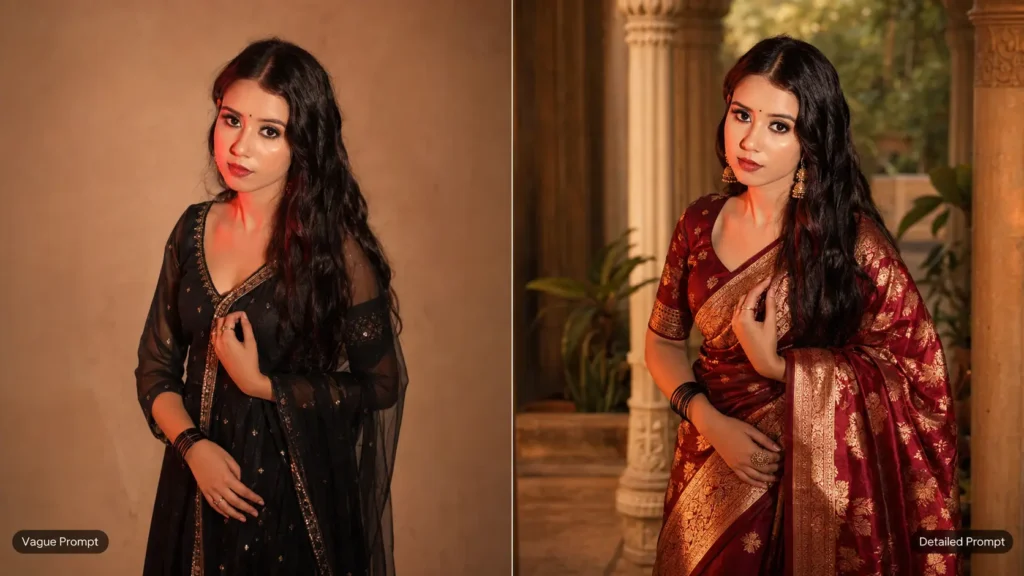
❌ Weak prompt
A woman wearing a traditional Indian dress, festive, colorful.
✅ Improved prompt — Try this
Portrait of a woman in a deep red Banarasi silk saree with gold zari
brocade border, paired with a matching embroidered blouse, jhumka
earrings, a bindi, hair in a braid with fresh jasmine. Seated in a
sunlit courtyard with terracotta walls, warm afternoon light, 85mm
lens, shallow depth of field, photorealistic.
🔁 Occasion variation — Navratri festival
Portrait of a woman in a Bandhani-print cotton lehenga in fuchsia
and yellow, gota patti border, layered bangles, hair in a braid with
flowers. Standing outdoors at a Navratri celebration with string
lights and rangoli patterns underfoot, warm evening light, 85mm
lens, photorealistic.
Cultural-accuracy note: Banarasi, Kanjeevaram, Bandhani, and Sambalpuri are not interchangeable — each names a specific weaving or dyeing technique tied to a specific region. If you’re unsure which applies, describe the visual pattern (tie-dye dots, woven ikat motifs, gold brocade border) rather than guessing at a regional name.
2. Japanese kimono
- Furisode — long, flowing sleeves, worn by unmarried women for formal occasions such as Coming of Age Day.
- Tomesode — shorter sleeves, patterned only below the waist, worn by married women at the most formal events, often with a family crest.
- Yukata — unlined cotton, casual, worn in summer or at festivals.
❌ Weak prompt
A person in a Japanese kimono, elegant, traditional.
✅ Improved prompt — Try this
Studio portrait of a woman in a formal silk furisode kimono with a
wisteria pattern, gold brocade obi sash tied in a traditional bow,
hair in a low chignon with a kanzashi ornament, shoji screen
background, soft diffused window light, 50mm lens, photorealistic,
fine silk texture visible.
🔁 Occasion variation — summer festival
Portrait of a woman in a cotton yukata in indigo and white floral
print, obi tied in a simple bow, wooden geta sandals, standing at
an outdoor evening festival with paper lanterns, warm ambient
light, 50mm lens, photorealistic.
Cultural-accuracy note: Furisode, tomesode, and yukata carry different formality levels and are not interchangeable — naming the wrong one for the occasion (a yukata at a formal ceremony, for instance) reads as a mistake to anyone familiar with the tradition.
3. Korean hanbok
A hanbok consists of a fitted jacket (jeogori) and a high-waisted skirt (chima) for women, or jeogori paired with wide trousers (baji) for men. Modern hanbok favors closer fitting and muted palettes; ceremonial hanbok uses fuller silhouettes and more saturated color blocking.
❌ Weak prompt
A person in traditional Korean clothing.
✅ Improved prompt — Try this
Full-body portrait of a woman in a pastel pink and mint hanbok with
a fitted jeogori jacket and full chima skirt, hair styled with a
traditional ribbon (daenggi), standing in a stone courtyard with
hanok rooftops in the background, soft natural daylight, 50mm lens,
photorealistic, subtle fabric grain.
🔁 Occasion variation — Seollal (Lunar New Year)
Family portrait in coordinated hanbok tones — soft blush and
sage green — seated on a traditional floor cushion indoors, warm
low lighting, relaxed family setting, 35mm lens, photorealistic.
Cultural-accuracy note: Color combinations in hanbok have traditionally signaled age, marital status, and occasion. If that context matters for your project, it’s worth confirming the pairing rather than choosing colors purely for contrast.
4. Chinese qipao
The qipao (also called cheongsam) is a fitted, high-collared dress, typically with side slits and a mandarin collar, associated with 1920s–30s Shanghai fashion as well as contemporary formal wear.
❌ Weak prompt
A woman in an elegant Chinese dress.
✅ Improved prompt — Try this
Portrait of a woman in a fitted red silk qipao with gold dragon
embroidery and a mandarin collar, hair in a classic updo, standing
in a lantern-lit alley, warm evening light, 85mm lens,
photorealistic, rich fabric sheen.
🔁 Occasion variation — modern formal event
Portrait of a woman in a solid emerald green silk qipao with
minimal embroidery, contemporary hairstyle, indoor evening
reception setting, soft ambient light, 85mm lens, photorealistic.
Cultural-accuracy note: Qipao spans a wide range of eras and formality, from plain daily wear to heavily embroidered ceremonial pieces. Naming the color, pattern, and embroidery level does more for accuracy than the word “elegant.”
5. West African textiles
Four distinct traditions are frequently flattened into “African print” or “tribal pattern” — both worth avoiding entirely.
- Ankara — industrially produced wax-print cotton in bold geometric or floral patterns, widely worn across West Africa.
- Kente — hand-woven by Akan artisans in Ghana, with specific patterns carrying specific names and meanings.
- Aso-oke — hand-woven by the Yoruba in Nigeria, used for agbada (men’s robes), iro and buba (women’s wrapper and blouse), and gele (head tie); denser and more textured than Ankara.
- Agbada — a large flowing men’s robe, traditionally made from aso-oke, worn over a shirt (dashiki) and trousers (shokoto).
❌ Weak prompt
African traditional dress, colorful, tribal pattern.
✅ Improved prompt — Try this
Full-body portrait of a woman in a bold Ankara wax-print dress in
orange and indigo geometric patterns, matching gele headwrap tied
in a structured fan shape, layered beaded jewelry, standing in
front of a market street with textile stalls, golden hour light,
35mm lens, photorealistic, saturated color grading.
🔁 Occasion variation — formal wedding
Portrait of a bride in hand-woven aso-oke fabric in sanyan beige
with a matching structured gele, gold jewelry, indoor reception
setting with warm decorative lighting, 85mm lens, photorealistic.
Cultural-accuracy note: Ankara, Kente, and Aso-oke are three separate textile traditions from different regions and production methods — industrial wax print, hand-woven Akan cloth, and hand-woven Yoruba cloth, respectively. “Tribal” is not an accurate substitute for any of them and is worth avoiding in prompts altogether.
6. Gulf and North African formal wear
- Abaya — a loose, flowing outer garment worn by women across the Gulf, ranging from plain black to heavily embellished versions for formal occasions.
- Thobe (also thawb) — a men’s ankle-length garment, typically white or muted, often paired with a ghutrah headscarf secured by an agal.
- Moroccan kaftan — a fuller, often heavily embroidered robe worn in North Africa, distinct in silhouette from the Gulf abaya, frequently paired with a wide belt (mdamma) for formal wear.
❌ Weak prompt
A person in Middle Eastern traditional clothing.
✅ Improved prompt — Try this
Portrait of a woman in a flowing emerald green abaya with
hand-stitched gold thread detailing along the sleeves, matching
silk hijab, gold filigree jewelry, standing in a courtyard with
mashrabiya lattice windows casting patterned shadows, warm
late-afternoon light, 85mm lens, photorealistic, rich fabric
texture.
🔁 Occasion variation — Moroccan wedding
Portrait of a bride in an ivory Moroccan kaftan with intricate
sfifa embroidery along the front seam and a wide embellished
mdamma belt, set against a riad courtyard with mosaic tilework,
warm golden light, 85mm lens, photorealistic.
Cultural-accuracy note: Abaya, thobe, and kaftan come from different regions and are cut differently — an abaya is not a kaftan with a different name, and neither should stand in for “Middle Eastern clothing” as a catch-all. For menswear, name the thobe and headscarf style directly rather than describing a generic robe.
7. European folk dress
- Dirndl — a Bavarian and Austrian dress with a fitted bodice, full skirt, and apron, still worn at regional festivals such as Oktoberfest.
- Scottish Highland dress — built around a kilt in a specific tartan (often clan-associated), typically paired with a sporran, tweed jacket, and sometimes a clan brooch.
❌ Weak prompt
European traditional costume, folk dress.
✅ Improved prompt — Try this
Portrait of a woman in a Bavarian dirndl with a fitted forest green
bodice, cream blouse with puffed sleeves, and a floral apron, hair
in twin braids with ribbon, standing in an alpine meadow with
mountains in the background, soft overcast light, 85mm lens,
photorealistic, natural color palette.
🔁 Occasion variation — Scottish Highland dress
Portrait of a man in a kilt in hunting Stewart tartan, tweed
jacket, sporran, standing in a misty highland landscape, moody
overcast light, 50mm lens, heritage outdoor photography style,
photorealistic.
Cultural-accuracy note: Tartan patterns (setts) are often associated with specific Scottish clans; naming a real tartan produces a more coherent result than describing “plaid” generically. Dirndl apron-bow placement traditionally signals marital status in some regions — worth checking if the detail matters for your project.
Editing an uploaded photo instead of generating from scratch
Most current tools — Gemini’s Nano Banana Pro in particular — support outfit-swapping directly on a reference photo rather than generating a person from nothing. This tends to produce more consistent results, but only if the prompt explicitly protects the parts of the photo you don’t want changed.
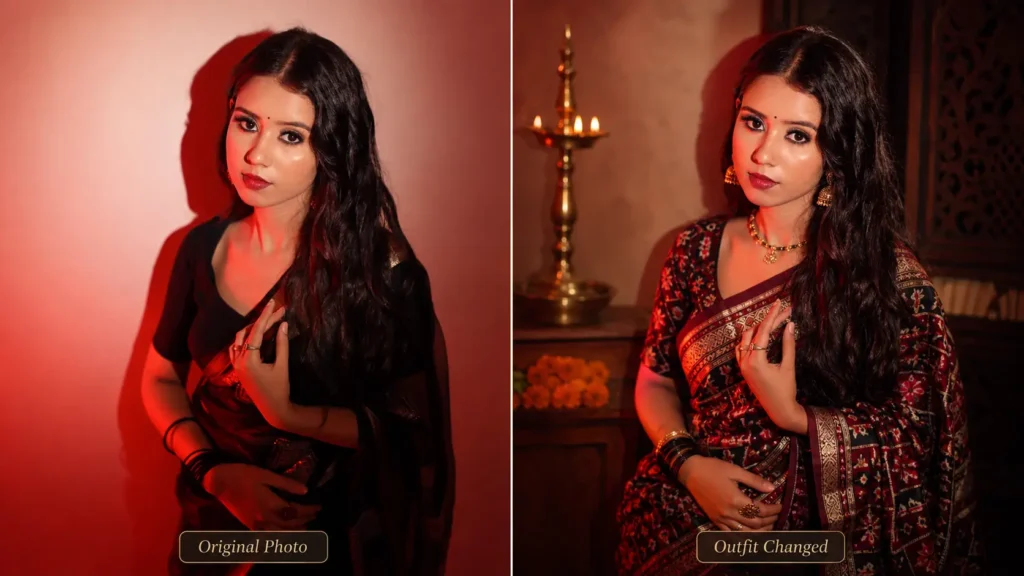
✅ Photo-editing prompt template — copy this
Using this photo, keep the person's face, skin tone, hairstyle,
body proportions, pose, and the original lighting exactly as
shown. Change only the clothing to [specific garment description
from the formulas above]. Do not alter facial features, expression,
or background lighting direction.
A few points that make a measurable difference:
- Be explicit about what stays the same, not just what changes. Tools default to subtly altering a face if you don’t instruct them to preserve it.
- Mention skin tone directly. Some models shift skin tone toward whatever they statistically associate with a named garment or region unless told not to.
- Keep the pose instruction separate from the outfit instruction. Folding a pose change into the outfit description increases the odds the model alters more than intended.
- Run one change per generation where possible. Swapping the outfit and the background and the lighting all at once raises the chance that something you wanted preserved gets altered along with it.
Troubleshooting
| Problem | Fix |
|---|---|
| Clothing looks like a generic gown with decoration added | Name the actual garment type and a specific craft technique — zardozi, shibori, Ankara wax print, aso-oke weave — instead of “ornate” or “traditional pattern” |
| Model mixes elements from different cultures | Replace the region name with the actual garment name, and where relevant, the specific ethnic or regional tradition |
| Jewelry, headwear, or hair styling is missing | List the specific pieces — jhumka earrings, kanzashi ornament, gele headwrap, sporran — rather than assuming “traditional look” implies them |
| Garment is draped or worn incorrectly | Add explicit draping instructions — “pallu draped over the left shoulder,” “obi tied in a traditional bow at the back” — instead of leaving the mechanics implied |
| Fabric looks flat or plastic | Add a texture cue in Layer 5: visible silk sheen, subtle woven texture, natural fabric folds catching light |
| Face or skin tone changes during a photo edit | Add the explicit preservation instruction from the photo-editing section, and keep the outfit change as the only edit in that generation |
| Group or family set doesn’t look cohesive | Keep fabric, craft-technique, and color-family language identical across every prompt in the set, changing only the garment and size-appropriate details |
Conclusion
This is only as accurate as the garment name behind it. Swapping a country label for an actual garment, fabric, and craft technique — and applying the Five-Layer structure consistently — is what separates a specific, recognizable result from a generic costume. The formulas above cover seven major traditions in enough detail to start from, but the underlying approach extends to any garment: name it precisely, describe its construction, and let the setting and light do the rest.