24 Bhai Dooj AI Prompts for Realistic Gemini AI Images
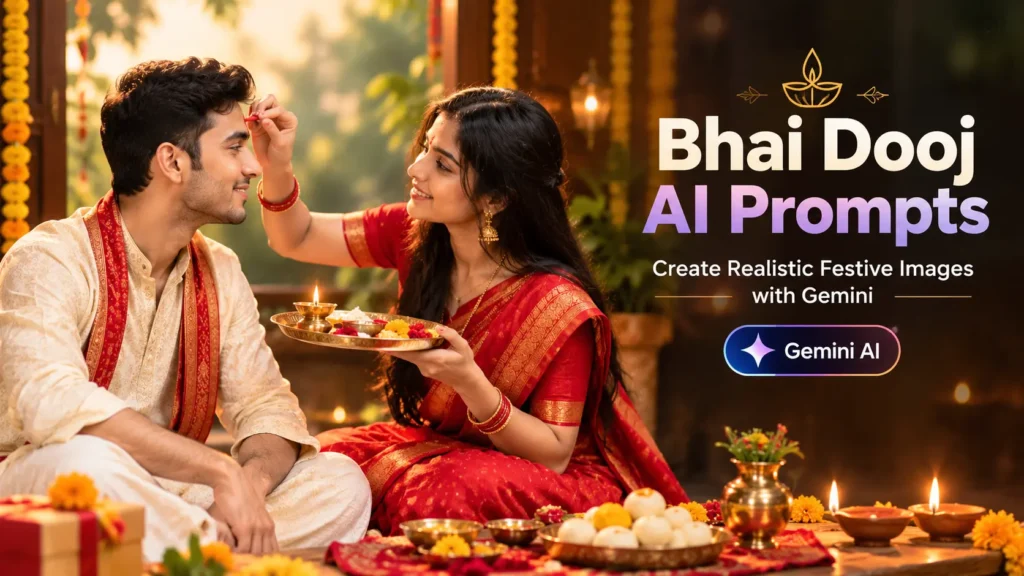
A good Bhai Dooj photograph is rarely about the filter. It is the thali held at a slightly awkward angle, the brother pretending to endure the tilak, the sister who has been fasting since morning and is mostly watching the sweets. Those are the details generic AI prompts get wrong, and they are what this guide is built around.
Below are 24 copy-and-paste Gemini prompts for Bhai Dooj and Bhai Phonta, grouped by situation: the Bengali phonta, regional Bhai Dooj customs, siblings who live apart, retro looks, modern portraits, and keepsakes you can print or send. After the prompts you’ll find the five-layer structure behind them so you can rewrite any prompt for your own family, then a ritual cheat-sheet, fixes for common problems and practical ways to use the finished images.
Discover more prompts👇
30 Google Gemini AI Photo Editing Prompts for Realistic, Social-Media-Ready Images
Gemini AI Photo Editing Prompts for Indian Festive Look
Set up in 60 seconds
Choose the photos. One clear, front-facing, well-lit photo of each person works best. Avoid sunglasses, heavy filters and group shots where faces are small.
Say who is who. When you upload separate photos, name them in the prompt: “Photo 1 is my sister, photo 2 is my brother.” Gemini can combine several uploaded photos into one scene, and it does better when it knows which face belongs to whom.
Paste, then swap the brackets. Anything in [square brackets] is yours to change: relationship, outfit, city.
Edit in steps. If something is off, don’t start over. Ask for one change at a time (“keep everything, change only her saree to deep green”). Gemini supports multi-turn editing, so each follow-up builds on the last image.
Bhai Phonta AI Prompts (Bengal)
Most Bhai Dooj prompts describe a red vermilion tilak. Bhai Phonta uses sandalwood paste, kajal, curd, paddy and durba grass, and these four prompts include them. Edit the plate to match your family’s.
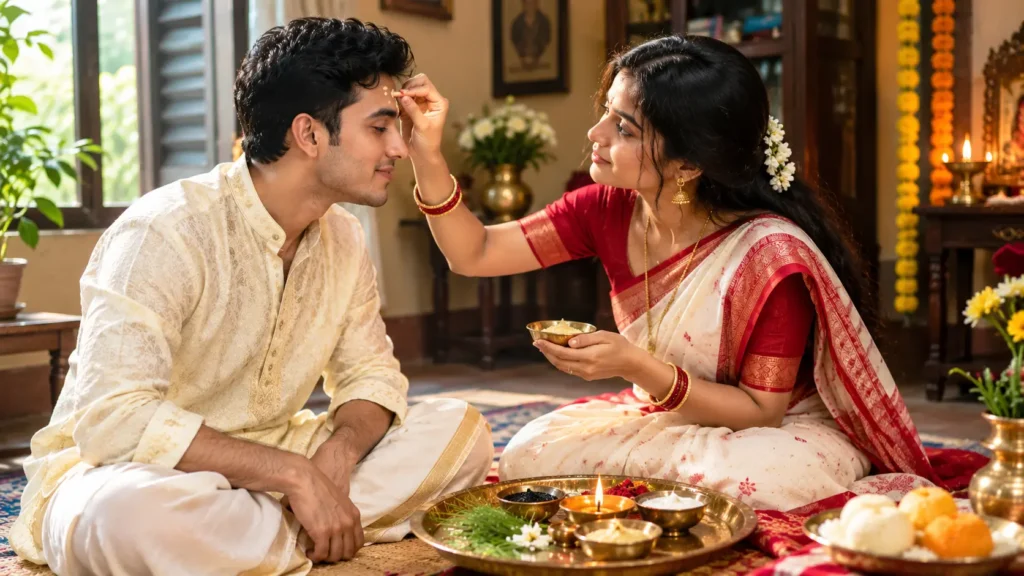
1. The phonta moment
Using the uploaded photos of me and my [younger brother], keep both faces, hair and skin tone exactly as in the originals. A Bengali sister places three small dots of sandalwood paste on her brother’s forehead with her little finger while he sits cross-legged on a small woven mat, eyes lowered. Beside them on a brass plate: a bowl of sandalwood paste, kajal, curd, a lit clay lamp, paddy with durba grass, and a few sweets. He wears a cream dhuti-panjabi; she wears a tant saree with a red border. Soft morning light from a window on the left, 50mm lens, shallow depth of field. He is trying not to smile; she is concentrating. Natural skin texture, no airbrushing, no text in the image.
If he is the elder brother, add: “After the phonta she bends to touch his feet.” If she is the elder, use Prompt 2.
2. The blessing with paddy and durba
Using the uploaded photos of me and my [younger brother], keep both faces exactly as in the originals. Waist-up shot: the elder sister gently places a pinch of paddy and fresh durba grass on her brother’s head as a blessing, three sandalwood dots already on his forehead. He looks up at her, slightly shy. Warm light from an oil lamp and a window, natural skin colour, soft film grain, 35mm lens. Only two people in the frame, hands anatomically correct, no text in the image.
3. The Bhai Phonta feast
Using the uploaded photos of me and my brother, keep both faces exactly as in the originals. The brother sits at a low table in a Bengali home, about to eat: hot luchi, a bowl of fish curry, rosogolla, sandesh and mishti doi in a small clay pot. The sister leans in to serve him one more luchi, both laughing mid-sentence. He wears a pastel panjabi, she wears a tant saree, a few diyas burn on a side table. Warm indoor light with a hint of daylight at the window, eye-level camera, unposed. No text in the image.
4. The gift exchange
Using the uploaded photos of me and my brother, keep both faces exactly as in the originals. Inside an old Kolkata house with green wooden shutters, the brother hands his sister a small wrapped gift while she pretends to inspect it suspiciously; an open sweet box sits on the table between them. She wears a silk saree, he wears a kurta. Afternoon sunlight falls through the shutters in stripes across the floor. Candid, slightly off-centre composition, 35mm lens. No text in the image.
Bhai Dooj AI Prompts by Region
Each prompt follows one regional custom, so the photo matches how your family does it. Customs differ between families and communities; edit the details to fit yours.
5. The classic tilak (North India)
Using the uploaded photos of me and my [brother], keep both faces, hair and skin tone exactly as in the originals. A sister applies a vermilion tilak with a few grains of rice to her brother’s forehead, holding a steel thali with a lit diya, sweets, a coconut and a small bowl of curd in her other hand. He sits on a low wooden stool in front of a fresh rangoli. She wears a bright salwar suit with a dupatta, he wears a kurta. Soft late-afternoon light from an open doorway, 50mm portrait lens, realistic warm colours. A little ceremonial, a hint of a smile on his face. No text in the image.
The afternoon light is deliberate: the traditional tilak window, aparahna, falls in the afternoon.
6. The Bhau Beej aarti (Maharashtra and Goa)
Using the uploaded photos of me and my [brother], keep both faces exactly as in the originals. A sister waves a lit aarti thali in slow circles in front of her brother’s face while he sits on a low wooden seat with a rangoli before him. The thali holds a small diya, kumkum, rice grains and a few sweets. She wears a cotton-silk saree, he wears a kurta-pyjama. The diya warms both faces; strings of marigold are softly blurred behind them. Candid medium shot, 50mm lens. He is grinning, she is serious about the ritual. No text in the image.
7. Bhai Tika (Nepal)
Using the uploaded photos of me and my [brother], keep both faces exactly as in the originals. A Nepali sister applies a multi-coloured Bhai Tika to her brother’s forehead while a thick marigold garland hangs around his neck. He wears a daura-suruwal and a dhaka topi, she wears a red-and-gold sari. Small oil lamps and strings of marigold behind them on a verandah. Bright, clear daylight, saturated but natural colours, 35mm lens. Dignified and happy. No text in the image.
8. Bhagini Hasta Bhojanam (Telugu homes)
Using the uploaded photos of me and my [brother], keep both faces exactly as in the originals. A brother sits cross-legged on the floor in front of a banana leaf laid with a festive meal while his sister, in a silk saree with jasmine in her hair, serves him a spoonful of payasam. He wears a white dhoti with an angavastram. A small brass lamp and a steel tumbler beside the leaf. Warm morning light, medium-wide frame at eye level, natural expressions. No text in the image.
AI Prompts for siblings who live apart
Combining two separate photos into one scene is the hardest case, so these prompts ask Gemini to match the light and sharpness between the two faces.
9. Two selfies, one tilak scene
Photo 1 is my sister, photo 2 is my brother. Keep each face exactly as in its own photo. Create one realistic photograph of them together in a living room on Bhai Dooj: she applies a tilak to his forehead from a thali with a diya and sweets; she wears a green silk salwar suit, he wears an ivory kurta. Make the lighting, skin tone and sharpness consistent between the two people so it looks like one photograph taken in one room. Warm evening light, 50mm lens, no text in the image.
10. The video-call phonta
Photo 1 is me, photo 2 is my brother. Keep both faces exactly as in the originals. A realistic photo of a laptop on a dining table showing a video call with the brother on screen, smiling. The sister, seen in three-quarter view so her face is visible, touches her fingertip with a dot of sandalwood paste to the screen near his forehead. Beside the laptop: a plate with a lamp, curd and sweets. Festive fairy lights behind her, warm lamp light mixed with the cool glow of the screen. No text in the image.
Sisters far from their brothers often give the phonta over a video call, touching the screen or a photo and sending sweets by post.
11. The surprise at the door
Photo 1 is me, photo 2 is my brother. Keep both faces exactly as in the originals. The brother stands at the front door with a small suitcase and a box of sweets, as if he has just arrived to surprise his sister for Bhai Dooj. She stands in the doorway with both hands over her mouth, laughing. A marigold toran above the door, small diyas on the floor, warm hallway light. Candid, eye-level, genuine surprise. No text in the image.
This is an imagined scene, so say so when you send it. “Next year, for real” is a good caption.
12. Two cities, one frame
Photo 1 is me, photo 2 is my brother. Keep both faces exactly as in the originals. A two-panel image side by side with a thin white divider. Left panel: the sister at home in India in the morning, preparing a thali with a diya and sweets, wearing a saree. Right panel: the brother in his apartment overseas in the evening, wearing a kurta over jeans, a box of sweets on the desk and a phone propped up against a mug. Both panels share the same warm colour palette and the same festive fairy lights. Realistic photography, no text in the image.
If one of you is in the US, a Tuesday-evening call is already Wednesday morning in India, so it counts as Bhai Dooj for both of you.
Retro and nostalgic AI Prompts
13. Recreate the childhood photo
Photo 1 is an old photo of my brother and me as children. Photo 2 is my sister today, photo 3 is my brother today. Recreate photo 1 with the two adults in the same poses, the same positions in the frame, the same background and the same camera angle, but dressed for Bhai Dooj in festive clothes. Keep the adult faces exactly as in photos 2 and 3. Keep the colour tone and soft focus of the original print. No text in the image.
14. The 1990s photo-studio portrait
Using the uploaded photos of me and my brother, keep both faces exactly as in the originals. A 1990s Indian neighbourhood photo-studio portrait: the siblings pose side by side in front of a painted pastel garden backdrop, stiff and slightly formal, a hint of a smile. She has a long braid and a salwar kurta, he has side-parted hair and a half-sleeve shirt. A small Bhai Dooj thali sits on a side table. Slightly over-bright flash, soft focus, faded warm print colours. No text in the image.
Google’s own Gemini page promotes a retro mall-studio portrait prompt, which is the same idea in a different setting.
15. Sparklers on the terrace
Using the uploaded photos of me and my brother, keep both faces exactly as in the originals. Two siblings on a terrace at dusk, each holding a sparkler at arm’s length, their faces lit warmly by the sparks, city lights blurred behind them. She is laughing, he is mock-ducking. Simple festive kurtas. Shot on 35mm film with visible grain and a slight glow around the lights. No text in the image.
16. The four-frame photo-booth strip
Using the uploaded photos of me and my brother, keep both faces exactly as in the originals. A vertical four-frame photo-booth strip of the two siblings against a plain curtain with a marigold garland draped along the top. Frame 1: posing seriously. Frame 2: laughing. Frame 3: the sister dabs a dot of sandalwood paste on her brother’s nose, and he looks startled. Frame 4: a tight hug. Slightly faded colour, flash lighting, thin white borders between the frames. No text in the image.
Modern and candid AI Prompts
17. Lit only by diyas
Using the uploaded photos of me and my brother, keep both faces exactly as in the originals. Two siblings leaning in close over a cluster of diyas on a table, a dark room, their faces lit only by the flames, orange glow on the skin, deep soft shadows, small flames reflected in their eyes. He rests his chin lightly on her shoulder. Quiet and affectionate, 85mm lens, shallow depth of field. No text in the image.
18. Mithai and chai
Using the uploaded photos of me and my brother, keep both faces exactly as in the originals. A café table by a window: a box of mithai, two small glasses of cutting chai. The sister holds a piece of kaju katli towards her brother’s mouth while he leans back to dodge it, both laughing. She wears a kurti and jeans, he wears a hoodie. Soft overcast daylight, candid street-style photograph, 35mm lens. No text in the image.
19. Rooftop at golden hour
Using the uploaded photos of me and my brother, keep both faces exactly as in the originals. The siblings sit on a rooftop parapet at golden hour with strings of fairy lights behind them and a soft city skyline. She teasingly straightens his kurta collar. Coordinated outfits in mustard and navy. 85mm lens, warm backlight with gentle rim light on the hair. Natural skin texture, no text in the image.
20. The clean studio portrait
Using the uploaded photos of me and my brother, keep both faces exactly as in the originals. A clean editorial studio portrait of the siblings standing shoulder to shoulder against a plain warm-grey backdrop, in coordinated festive outfits of deep maroon and ivory. Soft key light from the left with gentle fill, fabric and hair detail sharp, relaxed genuine smiles. Square 1:1 crop with room around their heads, suitable for a profile picture. No text in the image.
Keepsake AI Prompts
21. A watercolour portrait for framing
Using the uploaded photo of me and my brother, recreate us as a soft watercolour illustration with both faces clearly recognisable. The sister applies a tilak to her brother. Loose washes of orange and gold in the background with diya outlines and scattered marigold petals, visible paper texture, a white margin around the artwork as if ready for framing. Portrait 4:5 ratio. No text in the image.
22. A phone wallpaper
Using the uploaded photos of me and my brother, keep both faces exactly as in the originals. A vertical 9:16 phone wallpaper. The siblings sit small in the lower third of the frame on a rooftop at dusk, smiling at each other. The upper half is soft empty sky with a faint glow of bokeh lights, kept uncluttered so the clock and widgets stay readable. No text in the image.
23. A greeting-card background
Using the uploaded photos of me and my brother, keep both faces exactly as in the originals. A portrait-orientation greeting-card image: a border of marigolds and small diyas around the edges, the siblings shown waist-up in the lower half, and a large clean empty area in the upper half where I will add my own message later. Warm festive colours, soft light. No text in the image.
Add the message yourself in a design app, and proofread any Bengali or Hindi lettering letter by letter before you send it.
24. A sticker sheet
Using the uploaded photos of me and my brother, keep both faces recognisable in a cartoon style. A sheet of six sticker-style illustrations in a 3 by 2 grid on a plain white background, each with a thick white outline: the sister applying a tilak, the brother pretending to be scared, a high-five, sharing sweets, a hug, a thumbs-up. The same character design in all six. No text in the image.
The five-layer structure behind these prompts
Every prompt above is built from the same five layers. Learn the structure once and you can write a prompt for any family custom.
1. Likeness. Tell Gemini to keep faces, hair and skin tone exactly as in the originals, and name which photo is who. This single line does more than any amount of style language.
2. Ritual. Describe one action and the three or four objects that matter. Weak: “sister doing tilak on brother.” Strong: “three dots of sandalwood paste with her little finger, a plate with curd, kajal, a lamp, paddy and durba beside them.” This is the layer competing prompt lists skip, and it is why their images look like a generic Indian festival rather than your family’s.
3. Wardrobe and setting. Name the garments and the room. “Cream dhuti-panjabi” and “old Kolkata house with green shutters” give Gemini something to build; “traditional clothes” does not.
4. Light and camera. Write light the way a photographer would. Weak: “cinematic, ultra HD, 8K.” Strong: “soft morning light from a window on the left, 50mm lens, shallow depth of field.” Morning window light suits the phonta, soft afternoon light suits the traditional tilak hour, and diya light suits an evening portrait.
5. Feeling. One specific emotion beats a generic one. “Happy” gives you a poster. “He is trying not to smile; she is concentrating” gives you a photograph of two real siblings.
Here is the blank template:
Using the uploaded photos of [who], keep both faces, hair and skin tone exactly as in the originals. [Ritual: one action plus the three or four objects that matter]. [Wardrobe and setting]. [Light and camera]. [Feeling]. Natural skin texture, no airbrushing, no text in the image.
Fixing the common problems
The faces drift. Use clearer reference photos, cut the prompt to fewer details, and follow up with: “Keep both faces exactly as in the original photos and change only the clothing.” Changing one thing at a time keeps the likeness more stable than regenerating everything.
The ritual looks wrong. Reduce the scene to a single action, name the finger and the spot on the forehead, and add “only two people in the frame.” Extra hands and misplaced tilaks usually come from scenes asking for too much.
The skin looks plastic. Replace “ultra HD 8K” with “natural skin texture, no airbrushing.” Quality words like 4K rarely add detail, and they often add glossiness.
Strange tags in prompts you found online. Many circulating lists end with strings like “–vivid –4K.” That is Midjourney-style syntax, and Gemini reads plain language, so at best it is ignored. Say what you want in words, including the shape: “vertical 9:16” or “square 1:1.”
Which model are you using? In the Gemini app, new images start with Nano Banana 2, which is available on the free plan with daily limits. AI Plus, Pro and Ultra subscribers can regenerate an image with Nano Banana Pro from the three-dot menu (“Redo with Pro”), which is worth trying for crowded scenes, thalis with many objects and Prompt 12. Nano Banana Pro can output up to 2K resolution.
Using the Bhai Dooj AI images in real life
Send them early. If your brother is abroad, send the image the night before, or on Tuesday evening if one of you lives in the US or UK. It becomes the start of the call instead of a substitute for it.
Print one. Prompts 20 and 21 suit a framed print. At 2K, a roughly 5×7-inch print is comfortable; for anything larger, check the image at 100% zoom before ordering.
Write on the back. A short handwritten note on a printed photo does more than a caption on a screen.
Use the family group. Prompt 13, the childhood recreation, tends to start the conversation by itself: post it with the original beside it.
Make one for the sibling who never gets one. Brothers can make Prompts 18 or 19 as a gift for their sisters. The festival runs in both directions.
Before you upload: a few good habits
Their face is theirs too. Ask your sibling before using their photo, particularly for a surprise. Know where the photo goes. A personal photo is personal data, so check the privacy and activity settings of the app before uploading family images, and avoid uploading photos of other people’s children. Label it when you share it publicly. Gemini marks its images with an invisible SynthID watermark, and a short “made with AI” note keeps your followers’ trust.
An AI photo will not replace the plate, the lamp and the awkward minute of sitting still for the tilak. Used well, it does something smaller and kinder: it gives two people who cannot be in one room a picture of the day they would have had. If you made photos for Durga Puja last month, the Durga Puja Gemini prompts use the same likeness-first approach for solo and couple portraits.
Frequently Asked Questions
1. What is the best Gemini prompt for Bhai Dooj photos?
There is no single best prompt, but the strongest ones share five layers: likeness, ritual, wardrobe and setting, light and camera, and feeling. The template above is the fastest way to build one.
2. Can I make Bhai Dooj or Bhai Phonta photos from just one picture of us together?
Yes, but separate, clear, front-facing photos of each person usually keep faces more accurately. If you only have a joint photo, crop in so both faces are large.
3. Do I need a paid Gemini plan?
No. The free plan can create and edit images with daily limits, and paid plans add higher limits and the Pro option.
4. Do these prompts work in other AI tools?
Yes, it works with ChatGPT and other AI tools.
5. Can I use them for sisters, cousins or friends?
Yes. Swap the words. Many families also include cousins, friends and adopted siblings in the day.
6. When is Bhai Dooj 2026?
Wednesday 11 November in India (some calendars list the 10th), and Tuesday 10 November in the US, UK and UAE. See the date section above, and follow your family’s panjika.