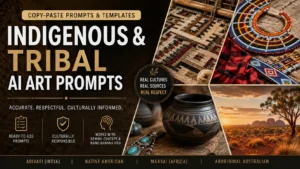
Ready-to-use prompts and fill-in-the-blank templates for Adivasi, Native American, Maasai, and Aboriginal Australian AI art — built to be accurate instead of stereotyped.
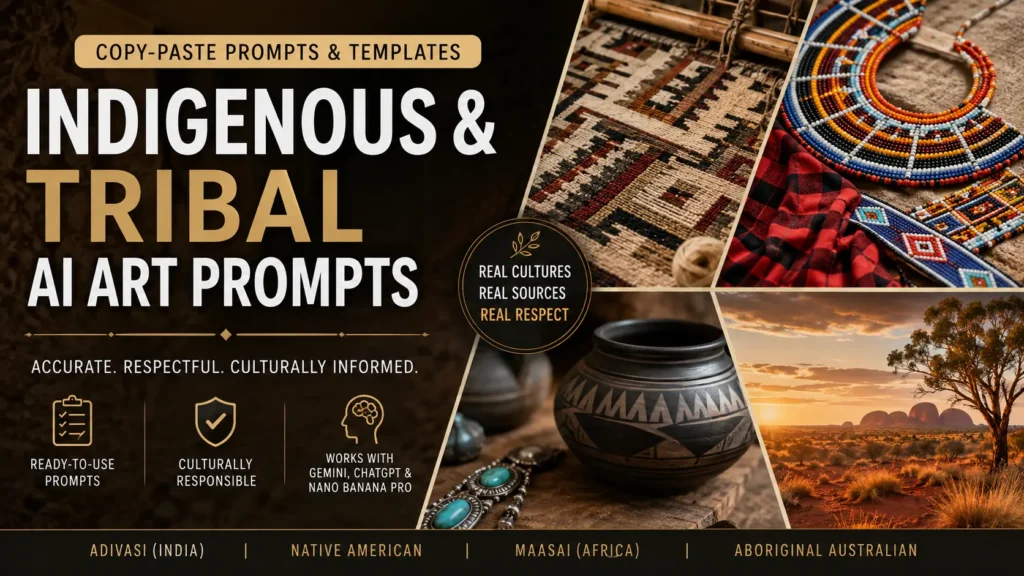
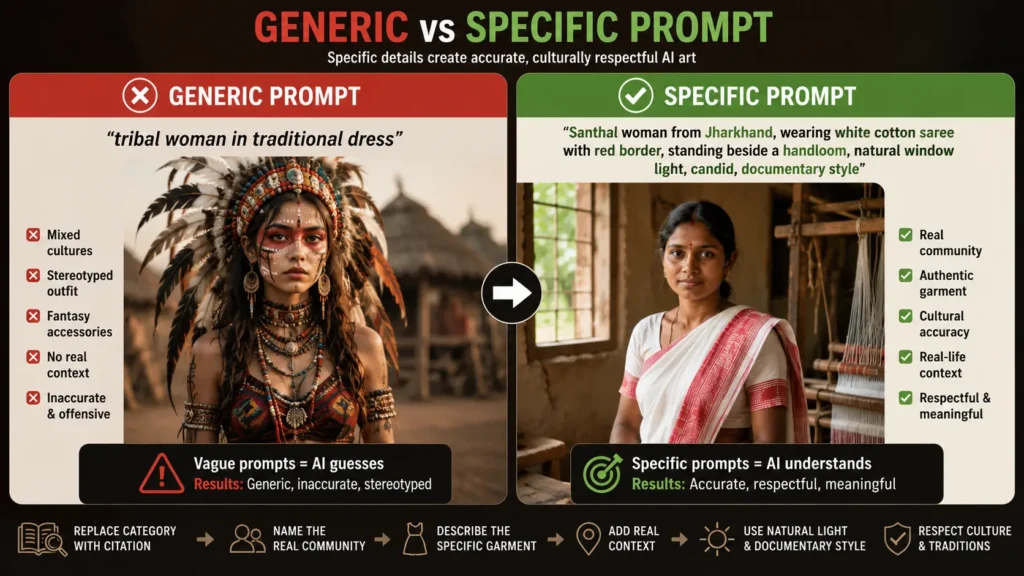
Generic “tribal” prompts produce inaccurate, stereotyped AI art because the word gives the model nothing real to work from. Swap “tribal” for a named community and a documented garment, and the results improve immediately — for both quality and respect. Below are ready-made prompts for four regions, plus templates so you can build your own for any culture.
Key takeaways:
- Never prompt with “tribal,” “ethnic,” or “exotic” alone — name the real community and garment instead
- Sacred and ceremonial items (headdresses, ritual regalia, restricted sacred designs) don’t belong in AI prompts, ever — the Hard-No list below covers what to skip
- Jump straight to The Prompts if you just want templates; scroll further for the research and reasoning behind them
Discover more👇
30+ AI Prompts for Body Painting Stunning Design Ideas 2026
Traditional Dress AI Prompt – How to Generate Culturally Accurate Attire with AI
The One Rule
AI models don’t know what “tribal” means, so when you use that word they guess — and the guess is almost always a stereotyped blend of unrelated cultures. The fix: replace the category with a citation. Name the actual community, the actual garment, and the actual region, and the model has something real to render instead of a stereotype to fall back on.
Hard no, always — these are earned, sacred, or spiritually restricted, not fashion elements: feather headdresses/war bonnets, ceremonial face or body paint, medicine bundles or religious regalia, and Aboriginal Dreaming-linked sacred designs. If an item signals someone earned, inherited, or was initiated into something specific within one community, leave it out of the prompt — no exceptions, no matter how the rest of the prompt is worded.
Everything below is built around that one rule.
The Universal Prompt Template
Use this structure for any culture, including ones not covered below:
[Documentary / editorial / studio product] photograph of [NAMED COMMUNITY], [SPECIFIC GARMENT OR OBJECT — material, pattern, color], [REAL SETTING], [LIGHTING STYLE], [composition note]
- Named community: a real, specific group — never “tribal” or “indigenous” alone
- Garment/object: something documented and non-ceremonial (check a museum collection or the community’s own cultural organization if unsure)
- Setting: somewhere the item actually appears in real life — a market, a workshop, a landscape — not a staged “exotic” backdrop
- Lighting: natural, documentary-style light reads as respectful; hyper-glamorized studio lighting tends to read as fetishizing
Adivasi (India) AI Art Prompts
Template:
Documentary-style portrait of a [COMMUNITY] [woman/man] from [STATE/REGION], wearing [GARMENT NAME] made of [MATERIAL], [PATTERN/COLOR DETAIL], [SETTING], [LIGHTING], candid unposed expression
Ready-to-use prompts:
Documentary-style portrait of a Santhal woman from the Jharkhand–West Bengal region of eastern India, wearing a white cotton saree with a red woven border, standing beside a wooden handloom, soft natural window light, candid unposed expression
Editorial portrait of a Bhil woman from Madhya Pradesh, wearing a colorful mirror-work ghagra skirt, seated in a village courtyard, soft overcast daylight, documentary photography style
Portrait of a Garo woman from Meghalaya, northeast India, wearing a dakmanda woven wrap skirt in a traditional geometric pattern, standing beside a bamboo house, warm late-afternoon light, candid expression
Portrait of a Mizo woman from Mizoram, northeast India, wearing a puan wrap-around skirt with intricate woven patterns, seated at a traditional loom, natural daylight, documentary photography style
Also works for: cultural heritage blog headers, handloom-revival storytelling, museum-style educational graphics.
Native American AI Art Prompts (Object-First Method)
This is the highest-risk region for stereotyping, so the technique shifts from person wearing something to the craft object itself — sidesteps the costume problem entirely and still produces striking results. Skip anything from the Hard-No list above; several nations, including the Navajo Nation, also hold formal trademark protection over their own name and specific pattern families.
Template:
[Studio product / documentary] photograph of a [CRAFT OBJECT] featuring a [DOCUMENTED PATTERN/STYLE NAME] from [NATION/REGION], made of [MATERIAL], [SETTING], [LIGHTING], [composition note]
Ready-to-use prompts:
Studio product photograph of a hand-woven wool rug featuring a Two Grey Hills-style Diné (Navajo) geometric pattern in undyed natural wool tones, displayed on a wooden loom, warm directional light, textile-catalog style
Documentary-style photograph of hand-coiled Pueblo blackware pottery with a matte-on-black geometric design, displayed on a wooden shelf, natural window light, macro detail shot emphasizing hand-burnished texture
Macro product photograph of a handcrafted silver and turquoise squash blossom necklace in the Southwest silversmithing tradition, laid on a neutral fabric backdrop, soft studio lighting, jewelry-catalog style
Also works for: craft-history content, home-decor mood boards, textile education pieces — anywhere the object, not a person “wearing an identity,” is the subject.
Maasai AI Art Prompts (East Africa)
Template:
[Documentary portrait / macro product] photograph of [Maasai elder/warrior/woman or specific garment], [SPECIFIC DETAIL: shuka pattern or beadwork], [REAL-LIFE SETTING], [LIGHTING], [composition note]
Ready-to-use prompts:
Documentary-style portrait of a Maasai elder wearing a red-and-black checked shuka wrap, herding cattle on the savanna at golden hour, natural sunlight, candid unposed expression
Macro product photograph of handwoven Maasai beadwork jewelry in orange and blue glass beads arranged in a geometric pattern, laid on a woven textile surface, natural daylight, craftsmanship-focused detail shot
Flat-lay product photograph of red-and-black checked Maasai shuka cloth, folded on a wooden surface, soft natural light, textile-catalog style emphasizing weave texture
Also works for: artisan-economy storytelling and ethical-sourcing content — the Maasai section below names where readers can buy the real thing.
Aboriginal Australian AI Art Prompts (Landscape-Only Method)
This is the one region where we’re not giving you pattern-generation prompts at all — most Aboriginal visual motifs are tied to a specific Dreaming story owned by a particular artist or family under Aboriginal law, so an AI approximation isn’t a gray area. Here’s why, and where to find the real thing instead. What is fully open to prompt: the landscape itself.
Template:
Wide landscape photograph of [SPECIFIC REGION/COUNTRY] at [TIME OF DAY], [TERRAIN/VEGETATION DETAIL], [SKY/WEATHER], documentary landscape photography
Ready-to-use prompts:
Wide landscape photograph of red ochre desert Country in Central Australia at golden hour, sparse eucalyptus and spinifex grass, dramatic streaked sky, documentary landscape photography
Wide landscape photograph of Kakadu wetlands in the Northern Territory at sunrise, paperbark trees and lily-covered water, soft misty light, documentary landscape photography
Wide landscape photograph of the Kimberley coastline in Western Australia at low tide, red sandstone cliffs meeting turquoise water, midday clear light, documentary landscape photography
Wide landscape photograph of temperate rainforest in Tasmania, moss-covered trees and fern understory, soft diffused overcast light, documentary landscape photography
Also works for: travel content, sustainability writeups — pair with a shoutout to a real Aboriginal-owned label rather than an AI stand-in for their designs.
Why This Approach Works
The prompts above will get you a long way on their own. This section is for readers who want the research and reasoning behind them.
Why generic prompts fail, not just offend
AI image models learn from however the internet captioned things — and web captions have long lumped Amazonian body paint, Maasai beadwork, Native American regalia, and Southeast Asian hill-tribe textiles under the same vague “tribal” tag, because whoever labeled the training data often didn’t know or didn’t specify which actual culture they were looking at. Ask a model for “tribal,” and it returns the average of that entire dumping ground.
This is documented, not anecdotal. One study of Stable Diffusion found the model rendered a large majority of Middle Eastern men in near-identical form — bearded, brown-skinned, in traditional attire — regardless of what the prompt actually specified, a pattern researchers call racial homogenization. Journalists who systematically tested these tools across dozens of countries found the same bias pattern repeatedly. The practical takeaway: specificity isn’t just the respectful choice, it’s the technically correct one. A vague prompt is an instruction to guess.
The headdress, explained
The Plains feather headdress (often called a war bonnet) is earned through specific acts of service within particular Native nations — closer to a military decoration than a fashion accessory. That’s the whole reason Native cultural organizations have been consistent for years that it doesn’t belong in costumes or “cool photo” prompts, regardless of intent. The same logic covers ceremonial paint, powwow regalia, and medicine bundles: if it’s tied to an earned role or spiritual practice, it’s not generic cultural expression.
Maasai, and the $10 million question
Unlike a general sensitivity issue, the Maasai case is an active, ongoing intellectual-property fight. The Maasai Intellectual Property Initiative, working with the advocacy group Light Years IP, has spent over a decade pushing back against fashion brands — Louis Vuitton, Ralph Lauren, and Calvin Klein among them — using Maasai patterns commercially without payment. One widely reported estimate puts the licensing revenue owed to Maasai communities at roughly ten million dollars a year that brands have never paid. Maasai beadwork also isn’t purely decorative: color and pattern signal age, marital status, and social standing within the community.
Why This Region Is Different
Most Aboriginal and Torres Strait Islander visual art — dot painting, cross-hatching, and related motifs — is frequently tied to a specific Dreaming story that belongs, under Aboriginal customary law, to a particular artist, family, or clan. That’s the entire basis of Australia’s Fake Art Harms Culture campaign, a coalition of the Arts Law Centre of Australia, the Indigenous Art Code, and the Copyright Agency that has spent years documenting a multi-million-dollar market in counterfeit “Aboriginal-style” souvenirs. An AI approximation of these motifs sits on the wrong side of exactly what that campaign exists to fight — which is why the landscape-only method above is the honest answer here, not a workaround.
If you want to feature real Aboriginal design work in your content, these are real, current, Aboriginal-led labels worth naming and linking to instead of generating an approximation: Ngali (founded by Denni Francisco, working directly with First Nations visual artists, 2022 National Indigenous Fashion Award winner), Maara Collective (founded by Yuwaalaraay woman Julie Shaw, licensing designs directly from Indigenous artists), and Magpie Goose (now wholly Aboriginal-owned, screen-printing in partnership with remote community art centres).
The methodology behind these templates
Each template above runs on the same five-layer logic: a named subject (never a category), garment/material described the way a textile catalog would, a real setting the item actually appears in, natural documentary lighting rather than glamorized staging, and dignified, candid framing over performative or sexualized posing — a real, long-documented problem in how stock photography has historically framed women from these communities.
Pre-Publish Checklist
| If your prompt says… | Do this instead |
|---|---|
| “Tribal,” “ethnic,” or “exotic” as the only descriptor | Name the actual community, region, and garment |
| A headdress, war bonnet, or ceremonial regalia item | Remove it — shift to an object, textile, or landscape focus |
| A generic “authentic native” backdrop | Use a real, documented setting the item actually appears in |
| Sexualized or performative posing | Candid, dignified, documentary-style framing |
| No source you could point to if someone asked | Stop and find one — a museum collection or an artisan cooperative’s own materials |
Frequently Asked Questions
1. Is it ever okay to use AI to generate an image of yourself wearing indigenous-inspired clothing?
If the item is ceremonial, sacred, or tied to earned status — no, regardless of intent. If it’s an everyday garment a community openly wears and sells to outsiders, sourcing it accurately and crediting the tradition is generally fine. When in doubt, treat it as a no.
2. Why does AI keep blending different indigenous cultures into one generic look?
Because the training data itself was often mislabeled this way — web captions have long lumped unrelated cultures under vague tags like “tribal.” Generic prompts give the model nothing else to go on, so it defaults to the stereotype.
3. Can I recreate my own family’s or community’s traditional dress with AI?
Yes — you have standing and context an outside creator doesn’t. The same accuracy principles still help: naming the specific garment and region gets a better result than a generic prompt, even for your own culture.
4. What’s the difference between “traditional dress” and “sacred regalia”?
Traditional dress is everyday or festive clothing worn openly, often sold to outsiders. Sacred regalia is tied to a specific spiritual role or initiation — not for anyone outside that role to wear, digitally or otherwise.
5. Is it only feathers that are off-limits for Native American content?
No. Feather headdresses are the most visible example, but the same logic covers ceremonial paint, powwow regalia, and medicine bundles — anything tied to an earned role or spiritual practice within a specific nation.
6. Can a brand legally use these patterns in AI-generated marketing content?
Increasingly, no, without real risk. The Maasai and several Native nations hold active trademark and IP protections over specific names and patterns, and brands have faced lawsuits and backlash for unauthorized use, AI-generated or not.
7. Is there anything usable for Aboriginal Australian content?
Yes, the landscape, and real Aboriginal-owned labels (Ngali, Maara Collective, Magpie Goose) you can feature and link to. Just don’t ask AI to generate an approximation of Dreaming-linked motifs — those belong to specific artists and families.
8. How do I find a real source to check my prompt against?
Museum textile collections, ethnographic studies, or the artisan cooperative’s own materials when one exists. If a quick search turns up nothing specific, narrow your prompt further rather than filling the gap with imagination.
The reusable part of this guide isn’t the specific examples — it’s the habit of naming a real source before you write the prompt. Apply that same question to any culture this article didn’t cover, and you’ll get better results every time.