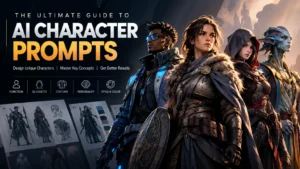
Most AI character prompts produce the same generic result. Here’s the five-layer method — and 36 ready-to-use prompts — that actually fixes it.
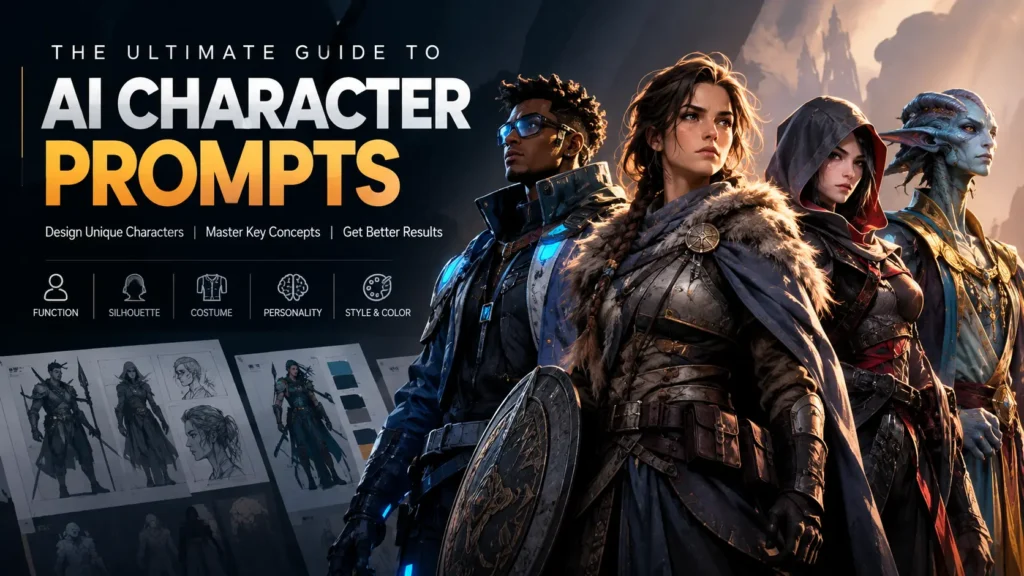
This article has 36 ready-to-use AI character prompts across eight categories. Copy one directly into Midjourney, Gemini, ChatGPT, or Ideogram, or swap the bracketed details in the template above each category to build your own variation. Everything below the library covers the specific techniques — silhouette testing, line of action, the 60-30-10 color rule — that make these prompts work, for anyone who wants to keep building past this list.
Discover more👇
AI Landscape Photography Prompts – The Framework for Cinematic Results
Traditional Dress AI Prompt – How to Generate Culturally Accurate Attire with AI
The AI Character Prompt Library
Each section opens with a reusable template — the customizable formula — followed by ready-to-copy example prompts built from it.
Fantasy Characters
Template:
[Role/archetype] from [specific world or environment], [dominant body shape], wearing [costume material + one sign of wear], [personality trait shown as posture or prop], [art style], [lighting/camera]
Prompts to try:
Frontline Knight: A veteran shield-bearer from a coastal fortress under constant siege, broad square shoulders and a low stance, wearing salt-corroded plate armor patched with mismatched rivets, standing with a shield planted firmly in front rather than raised, painterly concept-art style, cold overcast light, low camera angle
Rogue/Scout: A cliffside courier for a mountain trade guild, lean angular build with long limbs, wearing a weathered leather harness looped with rope and worn climbing hooks, crouched low with one hand already reaching for a hold, semi-realistic digital painting, dawn backlight, three-quarter angle
Battle Mage: A battlefield medic-mage from a war-torn borderland, slim upright frame with an oddly still posture, wearing a scorched healer’s robe with fresh burns over old mended patches, one hand glowing faintly while the other steadies a wounded soldier, painterly fantasy illustration, warm ember lighting, eye-level close shot
Village Elder: A retired lighthouse keeper who now trades weather warnings to sailors, round soft-shouldered build, wearing a thick oilskin coat faded from decades of salt spray, leaning on a carved walking stick worn smooth at the grip, storybook illustration style, soft golden-hour light, medium shot
Villain: A disgraced court advisor plotting from exile, sharp angular shoulders and an unnaturally straight spine, wearing formal robes deliberately kept pristine despite living in a ruin, one hand resting on a cane that’s clearly a weapon in disguise, dramatic painterly style, harsh side lighting, low three-quarter angle
Sci-Fi Characters
Template:
[Role aboard ship/colony] with [build suited to their job/environment], wearing [tech/gear with a specific material or function], [personality shown as posture or habit], [style], [lighting]
Prompts to try:
Starship Engineer: A propulsion engineer who’s spent more hours in zero-g than gravity, wiry build with unusually developed forearms from manual valve work, wearing a scorch-stained jumpsuit with a dozen hand-sewn tool loops, crouched mid-repair with a diagnostic light clenched in her teeth, hard-surface concept art style, cool blue panel lighting, close three-quarter angle
Original Alien Diplomat: A diplomat from a species that evolved on a tidally-locked planet in permanent twilight, elongated light-sensitive eyes and pale bioluminescent skin markings that pulse faintly when speaking, wearing layered translucent robes that filter harsh offworld light, calm symmetrical posture, painterly sci-fi illustration, soft ambient light, frontal portrait
Synthetic Companion: A decommissioned military synthetic repurposed as a household companion, boxy practical proportions with visible seams instead of a smooth “perfect” finish, matte gray chassis with one mismatched replacement arm panel, standing with arms held slightly too rigid out of old programming habit, semi-realistic 3D render, clinical white lighting, front-facing
Cyberpunk Mercenary: A freelance data courier navigating a city run by three rival corporations, compact low-profile build made for moving through crowds unnoticed, wearing a patched thermal jacket with exposed circuitry at one cuff, weight forward on the balls of the feet, neon-lit cyberpunk illustration, magenta and teal rim light, low angle
Colony Administrator: A first-generation colonist managing a failing water reclamation system, tired upright posture that still carries authority, wearing a faded formal uniform altered with practical repairs at the elbows, holding a data tablet like it’s the only thing keeping the colony running, realistic sci-fi illustration, harsh overhead fluorescent light, medium shot
Game Characters by Role
Template:
[Class/role] whose design signals ability at a glance, [silhouette shape matching the role], [gear that reinforces the role], [color accent tied to their power/type], game-asset-ready style
Prompts to try:
Tank: A frontline tank class built to read as immovable from across the map, wide blocky silhouette with an oversized shoulder guard breaking the outline, thick riveted plating scarred from repeated hits, deep red accent lights along the armor seams signaling “aggro” at a glance, clean game-asset concept art, neutral studio lighting, T-pose reference angle
Stealth/Assassin: A stealth class built to disappear into shadow within one second of stillness, narrow angular silhouette with no wide surfaces to catch light, matte dark fabric with no visible metal or buckles, a single thin blue accent line on the weapon signaling class from a distance, clean game-asset concept art, low-key lighting, three-quarter turnaround angle
Support/Healer: A support class designed to be instantly locatable by teammates in a chaotic fight, rounded soft-shouldered silhouette with a raised staff breaking the skyline, pale robes with one bright green glowing accent at the chest, calm open-handed pose, clean game-asset concept art, soft even lighting, front view
Mage/Caster: A ranged caster class whose silhouette reads as fragile on purpose, tall thin frame with an oversized flowing collar adding visual weight above the waist, robes embroidered with faintly glowing circuit-like patterns, purple accent light concentrated at the hands, clean game-asset concept art, dramatic rim lighting, three-quarter angle
Boss/Final Villain: A final-boss silhouette designed to dominate the screen from the character-select moment, oversized asymmetric shoulders with one limb exaggerated beyond natural proportions, cracked obsidian-like armor with molten orange fissures, a stillness in the pose that reads as barely restrained power, cinematic game-asset concept art, harsh top-down lighting, full-body front view
Personality-First Characters
Template:
[Character/role], [trait one] shown through [specific posture or habit], [trait two] shown through [specific asymmetry, prop, or color choice], expression described as a physical action
Prompts to try:
The Reluctant Leader: A reluctant leader thrust into command after her captain died, authority shown through squared shoulders held a beat too stiffly, uncertainty shown through hands that keep almost reaching for a weapon that isn’t there anymore, jaw set forward like she’s rehearsing what to say next, realistic illustration, neutral daylight, medium close shot
The Trickster: A trickster who talks their way out of everything, ease shown through a lopsided stance with all the weight on one leg, unpredictability shown through mismatched, half-buttoned clothing that looks deliberate rather than careless, a half-smile aimed slightly off-camera, stylized illustration, warm side light, three-quarter angle
The Guarded Loner: A guarded loner who trusts very few people, self-protection shown through arms crossed high and shoulders drawn inward, quiet confidence shown through steady, unblinking eye contact despite the closed posture, a single scar left deliberately unhidden, moody realistic illustration, cool low-key lighting, tight portrait crop
The Optimist: An unshakeable optimist in a group of cynics, warmth shown through an open stance with hands loosely at their sides, resilience shown through visibly patched but carefully clean clothing, chin lifted and eyes forward rather than down, bright storybook illustration, soft warm daylight, medium shot
Original Races & Species
Template:
[Original race name], adapted for [specific environmental challenge], with [an invented physical adaptation] and [an invented cultural practice or technology solving that challenge], [material/clothing suited to that environment], not based on any single real-world culture
Prompts to try:
Desert/Heat-Adapted: The Vantric, adapted for a binary-star desert with near-constant heat, with pale reflective skin that darkens temporarily for short night hunts and woven reed veils passed between generations as status markers, layered breathable wraps dyed with mineral pigments unique to their dune settlements, not based on any single real-world culture
Deep-Ocean Adapted: The Ithal, adapted for life in deep, lightless ocean trenches, with soft bioluminescent forearm patterns used for close-range communication instead of speech, translucent membrane fins grown longer through generations of free-diving, minimal clothing limited to pressure-woven harnesses for tool storage, not based on any single real-world culture
High-Altitude Adapted: The Corvane, adapted for life on wind-scoured mountain plateaus above the cloud line, with barrel-shaped chests built for thin air and calloused, wide-set feet suited to narrow ledges, heavy layered furs traded from lowland herders and reworked into wind-sealed cloaks, not based on any single real-world culture
Subterranean Adapted: The Morath, adapted for multi-generational life in lightless cave networks, with pale skin and enlarged heat-sensitive eyes replacing color vision entirely, clothing woven from cave-moss fiber dyed dark to avoid startling the nocturnal wildlife they herd, not based on any single real-world culture
Creatures & Companions
Believable invented creatures almost always come from combining two real animals for a specific shared reason — not just because the mashup looks interesting. Pick the reason first, then the two animals.
Template:
[Creature type/role] combining [real animal 1] and [real animal 2] chosen because [the shared trait or function], [a distinguishing feature tied to its role], [habitat detail], [art style], [lighting]
Prompts to try:
War-Mount: A war-mount bred for mountain cavalry, combining a mountain goat’s low center of gravity with a wolf’s powerful shoulders for uphill charges, thick double-layered fur suited to sudden temperature drops, scarred flanks from years of service, painterly creature concept art, overcast daylight, three-quarter angle showing full body and gait
Scholar’s Familiar: A scholar’s familiar bred for message-carrying between towers, combining a raven’s wing structure with a fox’s expressive facial mobility for genuine emotional readability, small enough to perch on a shoulder, a leather message-tube harness worn like everyday clothing, storybook illustration style, warm indoor lighting, close portrait
Cave Predator: A cave-dwelling predator that hunts by sound alone, combining a bat’s oversized ear structures with a spider’s multi-jointed limbs for silent movement over uneven rock, no visible eyes at all, dark painterly horror-fantasy style, single harsh light source from below
Temple Guardian: A temple guardian bred to recognize its keepers and no one else, combining a lion’s protective posture with a tortoise’s armored shell for a threat that can wait indefinitely, moss growing in the shell’s grooves suggesting centuries of stillness, mythological illustration style, dappled temple light
Xenofauna: A grazing herd animal native to a low-gravity moon, combining a giraffe’s long reach with a kangaroo’s powerful hind legs adapted for low-gravity bounding instead of walking, thin membrane skin suited to a cold, thin atmosphere, hard-surface sci-fi illustration, harsh unfiltered starlight
Color & Palette Prompts
Most professional character palettes follow the 60-30-10 ratio — one dominant color, one secondary, one accent — rather than leaving color to chance. Naming that ratio directly in a prompt produces noticeably more deliberate results.
Template:
[Character], primary palette of [dominant color] and [secondary color] in roughly a 60/30 split, a single accent color of [color] used only on [one specific detail], no more than [number] colors total, [style]
Prompts to try:
Hero Palette: A protagonist adventurer, primary palette of weathered brown leather and faded denim blue in roughly a 60/30 split, a single gold accent used only on a family heirloom pendant so the eye goes there first, no more than four colors total, painterly illustration style
Villain Palette: An antagonist sorcerer, primary palette of charcoal black and deep bruised purple in roughly a 60/30 split, a single cold white accent used only in the eyes to suggest something unnatural, no more than three colors total, dramatic painterly style
Ensemble Cast: Three siblings from the same family design, sharing one base palette of muted forest green, each assigned one unique accent color — rust orange for the eldest, pale yellow for the middle child, dusty rose for the youngest — so all three read as related but instantly distinguishable in a group shot, storybook illustration style
Faction Identity: A soldier from a desert-based faction, primary palette of sun-bleached tan and rust red pulled from their home terrain, one shared faction accent of deep teal worn as a sash so allies are identifiable at a glance across the whole army, realistic military illustration style
Character Sheets & Consistency Prompts
Template:
Character reference sheet for [name/role], [specific views needed], same lighting and pose height across all views, [core physical description], [core costume description], neutral background, consistent proportions throughout
Prompts to try:
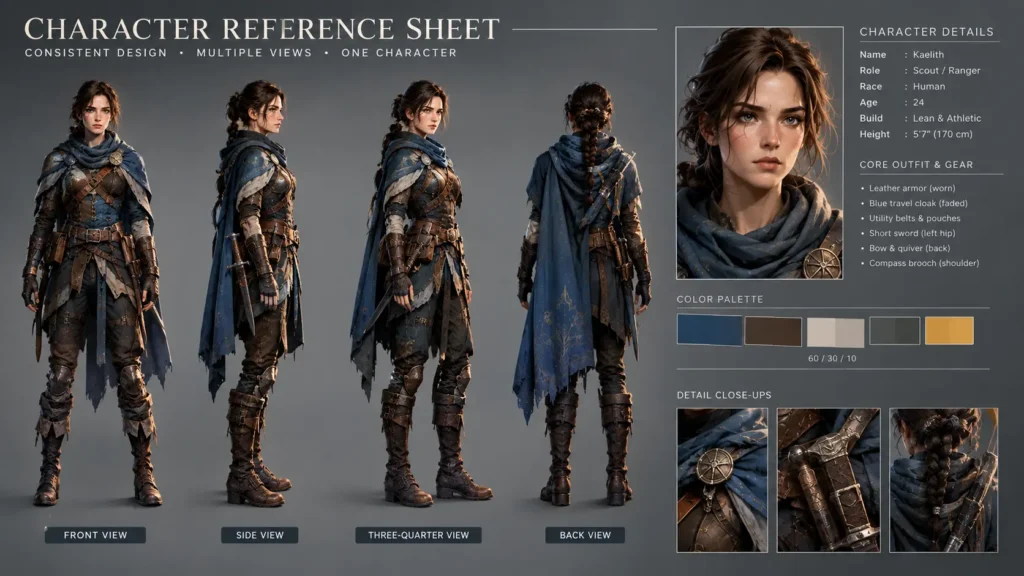
Full Turnaround: Character reference sheet for a wandering bounty hunter, front view, side view, three-quarter view, and back view, same lighting and pose height across all four, weathered man in his 40s with a shaved head and a burn scar across the left jaw, wearing a sun-faded canvas duster over segmented leather plating, neutral gray background, consistent proportions across all views
Expression Sheet: Character expression sheet for the same battle mage above, six-panel grid showing calm, focused, exhausted, alarmed, relieved, and determined expressions, head and shoulders only, identical lighting and framing in every panel, neutral background, consistent facial proportions throughout
Outfit-Variant Sheet: Character outfit sheet for the same starship engineer, three panels showing her work jumpsuit, formal colony uniform, and off-duty casual clothing, same face, hairstyle, and build in every panel, identical neutral pose and lighting, plain background, labeled with outfit names beneath each panel
Action Pose Sheet: Character action reference sheet for the same stealth-class character, four panels showing a crouched idle stance, a mid-sprint pose, a climbing pose, and a ready-to-strike pose, consistent proportions, costume, and lighting across all four panels, neutral background, game-asset concept art style
The Framework Behind These Prompts
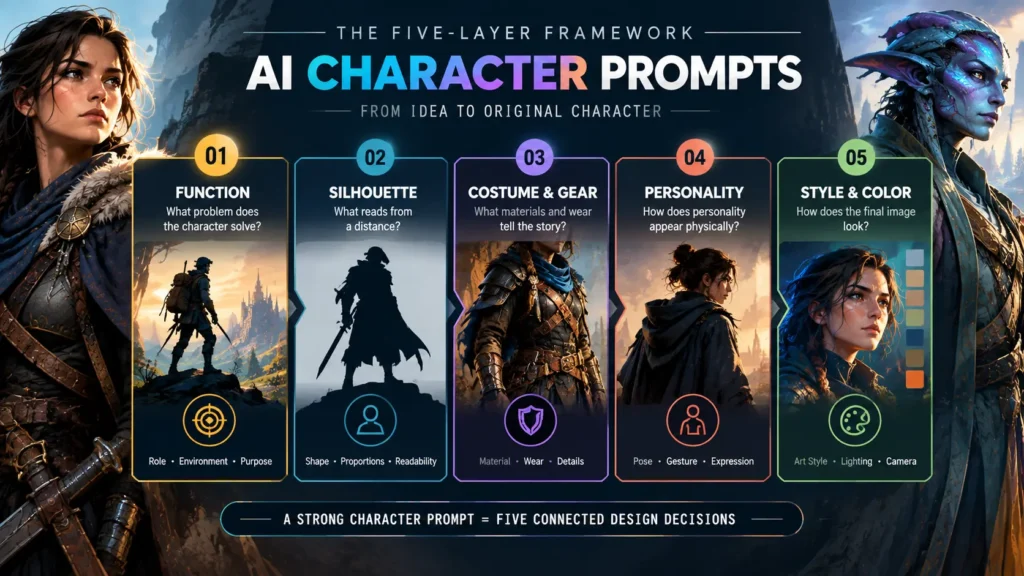
Every prompt above is built on the same five-layer method professional character designers use, so you can keep generating original prompts long after you’ve worked through this list. Vague prompts (“epic warrior,” “mysterious mage”) produce generic results because, without a defined shape or function, the model defaults to the visual average of everything similar it has seen. Naming a shape, a role, and a ratio gives it something structural to build from instead.
| Layer | What It Controls | Ask Yourself |
|---|---|---|
| 1. Function | The problem the character or race solves | What environment or conflict shaped them? |
| 2. Silhouette | Readability at a glance | Would this read from a solid black shape? |
| 3. Costume & Gear | Material, wear, and role-signaling | What material — and what sign of wear? |
| 4. Personality | Traits shown physically, not named | What posture, or line of action, shows this trait? |
| 5. Style & Color | Consistent rendering and palette | What’s the dominant, secondary, and accent color? |
Two specific techniques inside that table are worth calling out on their own, because most character prompts skip them entirely:
Line of action. This is the single curve — usually a C, reverse-C, or S shape — that runs through a character’s spine and gives even a still pose a sense of energy instead of stiffness. Describing that curve directly (“spine arched into a reverse-C as she leans back mid-laugh”) does more for a pose than any number of adjectives.
The 60-30-10 color rule. One dominant color covers roughly 60% of the design, a secondary color covers about 30%, and a single accent color takes the remaining 10% — the part the eye goes to first. Leaving color unspecified is one of the most common reasons an otherwise detailed prompt still comes back looking unfinished.
Pro tip — test the silhouette before adding detail. Generate the character as a flat shape first: “[character role], solid black silhouette only, no internal detail, plain white background, side profile pose.” If the role isn’t recognizable from the outline alone, fix the shape before spending any more of the prompt on color or costume.
Troubleshooting
| Problem | Likely Cause | Fix |
|---|---|---|
| Character looks generic despite a detailed prompt | Prompt lists adjectives but skips silhouette and shape | Run it through the silhouette test above before adding surface detail |
| Two invented races look almost identical | Vague, single-adjective descriptions like “tall and elegant” | Give each race its own dominant shape and one signature adaptation |
| Colors look muddy or busy | Too many competing hues, no clear dominant color | Apply the 60-30-10 rule — one dominant, one secondary, one accent |
| Invented creature looks like a random mashup | The two source animals share no real functional link | Pick a shared reason first (both predators, both camouflaged) before choosing species |
| Pose looks stiff even with an “action” description named | No line of action defined | Describe the spine’s curve directly (C, reverse-C, or S shape) |
| Hands or small props distort across repeated edits | Small geometry drifts fastest across sequential edits | Limit edits per source image; regenerate fresh from the original reference periodically |
Frequently Asked Questions
1. How detailed should a character prompt be?
Detailed enough to cover five things: the character’s function, a dominant silhouette shape, one costume material with a sign of wear, a personality trait shown physically, and a style or color choice. That combination consistently outperforms a longer prompt stacked with vague adjectives like “epic” or “stunning” — specificity matters more than length.
2. How do I keep an AI character consistent across multiple images?
Generate one clean, front-facing reference image first, using one of the Character Sheet prompts above, then feed that exact image back in for every new scene instead of re-typing the description. One good reference image is usually enough to start; add more only when several characters need to stay consistent together in the same scene.
3. Can I use AI character art commercially, in a game or book?
This depends on the terms of service of the specific tool you used, and those terms differ by platform and change over time — check the current commercial-use policy before publishing. Also consider whether your design resembles a copyrighted character or real person closely enough to raise a separate legal question of its own.
4. How do I design an original fantasy race without copying a real culture?
Start from a specific environmental problem the race has to solve, invent the adaptation that solves it, and draw loosely from multiple research sources rather than one. If a race’s defining features map cleanly onto one real ethnic group’s specific clothing, hairstyle, or markings, that’s a sign to mix your inspirations further.
5. Why do my AI characters all look generic?
Most often because the prompt lists surface adjectives without defining a silhouette or shape first. Describing the character as a flat black shape usually reveals the problem immediately — if the role isn’t readable from the outline alone, adding more detail won’t fix it.
6. How do I design a believable non-humanoid creature?
Combine two real animals chosen for a shared functional reason, not just because the mashup sounds interesting — a mountain mount might merge a goat’s sure-footedness with a wolf’s power, for instance. Anchoring an invented creature in real anatomy and locomotion is what makes it read as believable instead of a random assortment of parts.
7. How many colors should a character design use?
Most professional designs use the 60-30-10 ratio: one dominant color for roughly 60% of the design, a secondary color for about 30%, and a single accent color for the remaining 10% that draws the eye first. Naming this ratio directly in a prompt produces noticeably more intentional-looking results than leaving color unspecified.
8. Do I need art or design skills to use these prompts?
No. Every template in this guide translates professional character-design principles into plain descriptive language, so no drawing skill is required to apply them. What matters more than art training is specificity — naming an exact material, posture, or color ratio will always outperform a vague adjective.