Learn the 5-Layer Framework Used by Professional Photographers—Then Generate Cinematic Landscapes Every Time
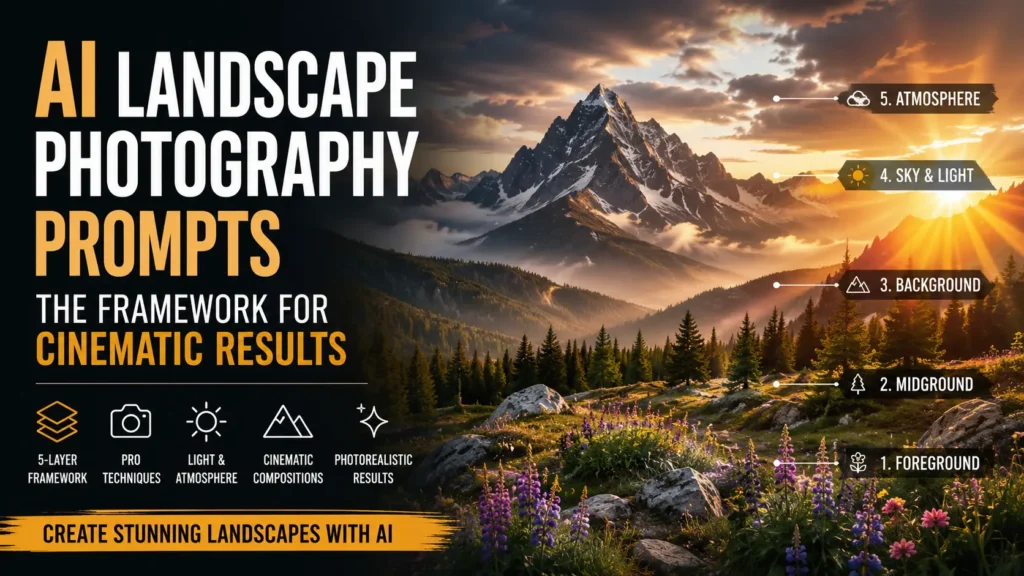
You type: “Beautiful mountain at sunset” into ChatGPT, Midjourney, or Gemini.
You get: A pleasant mountain. A serviceable sunset. But nothing that makes you stop scrolling. Nothing that looks like it belongs in a professional landscape photographer’s portfolio.
Here’s the uncomfortable truth: most AI landscape prompts fail because they’re written like wish-lists, not like how professional photographers think. When a landscape photographer picks up their camera, they don’t just think “mountain.” They think about layers.
Foreground interest. Is there something in the immediate area—wildflowers, rocks, a fallen log—that pulls the eye into the frame?
Midground subject. What’s the star of the photo? The mountain? A lake? A forest?
Background depth. What’s behind it? How does it create distance and scale?
Sky drama. Is it clear? Cloudy? Does it support or distract from the scene?
Atmospheric magic. Are there fog, mist, god rays, or haze that add emotion and dimension?
Most AI landscape prompts completely ignore this structure. They’re flat lists of things. And AI responds in kind: flat, generic, forgettable results.
Here you’ll learn the framework that professional landscape photographers use—and how to translate it into AI prompts across ChatGPT, Midjourney, Gemini, and Ideogram. By the end, you’ll be able to create landscape images that rival stock photography websites, not just look “pretty enough.”
The Landscape Photography Framework in Layers
Before we get to prompts, you need to understand the framework. This is the foundational skill that separates average AI landscape images from exceptional ones.
The Five-Layer Structure
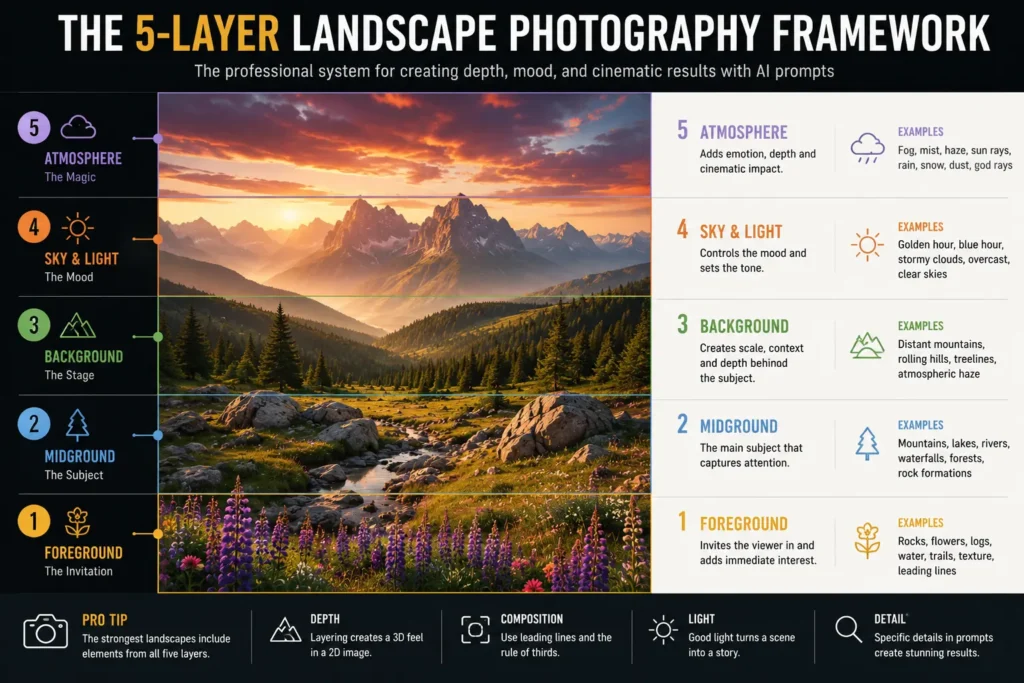
Every professional landscape photograph—and every great AI-generated landscape—is built on five deliberate layers:
Layer 1: Foreground (The Invitation)
Your foreground is what invites the viewer’s eye into the photo. It’s the close-up, immediate element. Without it, your landscape looks like a postcard from a gift shop. With it, it becomes an experience.
Foreground examples:
- A field of wildflowers with shallow depth of field
- Weathered rocks with moss and lichen detail
- A wooden fence leading into the distance
- Crystal-clear water reflecting the sky
- A hiking trail with footprints in sand or snow
Why it matters in AI prompts: AI generators often struggle with foreground detail because they’re focused on the background. If you explicitly describe the foreground, you force the AI to include it. This adds immediate visual interest and depth.
Layer 2: Midground (The Subject)
This is the “hero” of your image—usually the element that inspired you to take the photo in the first place. A mountain. A waterfall. A lake. A forest.
In AI prompts, you need to be specific about the midground:
- Not “mountain,” but “snow-capped mountain with jagged peaks”
- Not “waterfall,” but “cascade waterfall with white water against dark basalt cliffs”
- Not “lake,” but “glacial blue lake with mirror-still reflections”
Layer 3: Background (The Stage)
What’s behind your subject? The background creates scale, context, and visual separation from your midground.
Background examples:
- Rolling hills creating layers of depth
- A distant treeline creating a wall
- Sky that takes up 40% of the frame
- Atmospheric haze suggesting distance
Layer 4: Sky & Light (The Mood)
The sky is 30–60% of a landscape image. It controls mood entirely. A harsh blue sky feels different from golden hour light. Storm clouds feel different from clear skies.
This is where time of day matters enormously:
- Golden hour (first hour after sunrise, last hour before sunset): warm, soft, forgiving
- Blue hour (just after sunset, just before sunrise): cool, moody, surreal
- Midday: harsh shadows, high contrast (harder to pull off in AI)
- Overcast: soft, diffused, moody
Layer 5: Atmosphere (The Magic)
This is fog, mist, haze, dust, rain, snow, or god rays. It’s the thing that turns a good landscape into an unforgettable one.
Why atmosphere is crucial in AI: Most basic prompts ignore this. AI landscape generators respond exceptionally well to atmospheric cues. A single atmospheric modifier—”volumetric fog” or “sun rays breaking through clouds”—can transform a generic image into something cinematic.
The Prompt Structure That Works
Now that you understand the framework, here’s how to structure your actual prompts. This template works across all major AI tools.
The Landscape Prompt Template
[FOREGROUND ELEMENT], [MIDGROUND SUBJECT], [BACKGROUND DEPTH],
captured with [CAMERA SPECIFICATIONS], [TIME OF DAY/LIGHTING],
[ATMOSPHERIC EFFECT], [MOOD/STYLE DESCRIPTOR], [PHOTOREALISM MODIFIER]
Breaking It Down With a Real Example
Generic prompt (you see 1000 of these):
Beautiful mountain landscape at sunset
Professional prompt (using our framework):
Alpine meadow filled with lupine flowers and scattered boulders in the foreground, dramatic snow-capped mountain peak dominating the center, rolling forested foothills creating depth in the background, captured with a 35mm lens at golden hour with warm, directional light from the left, volumetric fog clinging to the mountain slopes with sun rays breaking through, cinematic and immersive, shot on Hasselblad H6D, ultra-detailed, photorealistic
Notice the difference? The second prompt has layers, specificity, and atmospheric intention. It tells the AI exactly where to put things, what time of day it is, what the light looks like, and what emotional element (the fog) should be included.
The Five Essential Landscape Categories: Templates & Copy-Paste Prompts
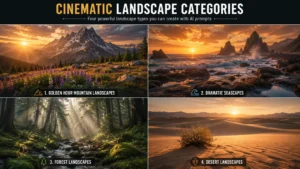
Now let’s get to the practical part. Below are the five landscape types that rank highest in AI art and deliver the most reliably stunning results. For each category, I’ve provided the thinking behind it, the technical elements that matter, and copy-paste prompts for ChatGPT, Midjourney, Gemini, and Ideogram.
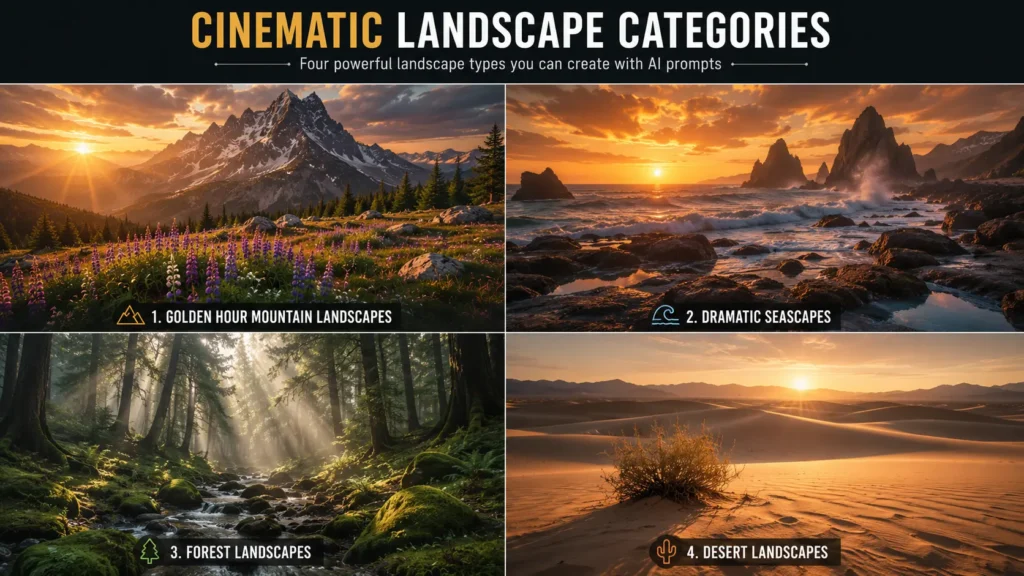
Category 1: Golden Hour Mountain Landscapes
Why this works: Mountains at golden hour are inherently dramatic. The angled light creates texture and shadow. The warm color palette is universally appealing. This is the easiest category to make look professional.
Technical elements to include:
- Specific time: “golden hour,” “last light,” or “10 minutes before sunset”
- Directional light: “side-lighting from the left/right”
- Foreground: wildflowers, alpine meadow, or rocky foreground
- Atmospheric modifier: “crisp air with haze in the valley” or “light mist in the foothills”
- Lens: 24mm (wide, dramatic) to 85mm (more intimate)
Prompt 1: Alpine Meadow at Golden Hour
Works best on: Midjourney, DALL-E, Gemini
Alpine meadow filled with purple lupine and golden grass, weathered granite boulders scattered throughout, jagged mountain peak with early snow in the background, captured at golden hour with warm directional light coming from the left, volumetric light rays breaking through thin clouds, cool shadows in the foreground, shot on a 50mm lens with cinematic color grading, photorealistic, ultra high definition, immersive landscape photography
Quick adjustment guide:
- Change the flowers: Replace “lupine” with “wildflowers,” “columbine,” “blanket flowers,” or “Indian paintbrush” (for more regional specificity)
- Change the mountain: Replace “jagged granite” with “volcanic,” “sedimentary,” or “limestone”
- Change the time: Replace “golden hour” with “blue hour” for cool tones, or “magic hour” for softer light
- For ChatGPT Image: Keep it under 200 words. This prompt works at 170 words.
- For Ideogram: Simplify to 100–120 words, focusing on the key visual elements
Prompt 2: Mountain Valley with Morning Mist
Works best on: ChatGPT Image, Gemini
Misty mountain valley in early morning, dense evergreen forest creating a dark frame in the foreground, mountain valley opening up to a snow-peaked range in the background, thick fog clinging to the valley floor with golden sun rays penetrating the mist, cool blue-grey color palette with warm light accents, shot on a 35mm lens, cinematic, moody, photorealistic landscape, volumetric atmosphere, shot by a professional landscape photographer
Why this works: Mist and fog are things AI generators excel at. The combination of atmospheric effect + directional light creates instant cinematicism. The mention of specific light (golden rays through mist) forces the AI to compose the lighting deliberately rather than randomly.
For Indian landscapes: Replace the evergreen forest with “dense sal forest” or “Himalayan cedar” for regional specificity.
Category 2: Dramatic Seascapes & Coastal Landscapes
Why this works: Water is dynamic. Waves, reflections, and coastal cliffs create natural drama. This category performs exceptionally well on Instagram and as wallpapers.
Technical elements to include:
- Wave action: “crashing waves,” “calm water,” or “turbulent seas”
- Coastal feature: cliffs, rocks, sandy beach, sea stacks
- Time of day: usually golden hour or blue hour (midday is flat on water)
- Atmospheric element: spray, mist, storms, clear skies
- Foreground: rocks, sand, tide pools, or seaweed
Prompt 3: Rocky Coastline at Golden Hour
Works best on: Midjourney, DALL-E
Dramatic rocky coastline with dark basalt formations, white waves crashing against ancient weathered rocks, white sea spray catching golden hour light, warm orange and purple sky with soft clouds, fine mist from the ocean creating a hazy atmosphere, distant headland creating depth, captured on a 24mm ultra-wide lens, cinematic color grading, photorealistic, professional seascape photography, shot on a full-frame DSLR, high detail and texture
Technique note: The specificity of “basalt formations” and “weathered rocks” tells the AI the kind of texture and color to render. Generic “rocky coast” gets ignored. Specific rock types = specific visual treatment.
Prompt 4: Serene Beach at Blue Hour
Works best on: ChatGPT Image, Gemini, Ideogram
Empty sandy beach during blue hour (just after sunset), calm water like glass reflecting the twilight sky, a single wooden pier leading into the distance, cool blue and purple tones with the last hints of warm light on the horizon, gentle waves lapping at the shore, soft sand in the foreground catching the cool light, shot on a 35mm lens, peaceful and meditative, photorealistic, atmospheric seascape
Why blue hour works: It’s inherently moody and cinematic. It also produces cooler color palettes that feel more sophisticated than the typical orange-and-blue look.
For Indian coastal content: Use “Kerala backwaters at dusk” or “Arabian Sea rocky coast” to target regional searches.
Category 3: Forest & Woodland Landscapes
Why this works: Forests are intimate. They create visual mystery. AI handles forest texture and depth extremely well, especially when you specify atmospheric elements.
Technical elements to include:
- Forest type: dense, sparse, old-growth, mixed deciduous
- Lighting: dappled sunlight, god rays, mist, overcast
- Foreground: ferns, moss, fallen logs, undergrowth
- Depth: layers of trees creating atmospheric perspective
- Season: green, autumn colors, snow, new growth
Prompt 5: Misty Old-Growth Forest
Works best on: Midjourney, Gemini
Ancient old-growth forest with massive conifer trees towering overhead, dense green understory with ferns and moss-covered boulders in the foreground, thick morning mist weaving through the trees, shafts of golden sunlight breaking through the canopy creating god rays, cool and earthy color palette with warm light accents, shot with a 50mm lens capturing the sense of scale and immensity, cinematic, moody, photorealistic, ultra-detailed texture, professional landscape photography
Specific element that makes this work: “God rays breaking through” is a visual cue that forces the AI to render directional light. Without it, you get a flat misty forest. With it, you get cathedral-like drama.
Prompt 6: Autumn Forest Path
Works best on: ChatGPT Image, Ideogram
Winding forest path covered with fallen autumn leaves in shades of gold, amber, and deep red, dense trees creating a natural archway overhead, dappled sunlight creating patterns on the path, warm color palette with cool shadows, shot on a 35mm lens, peaceful and nostalgic, photorealistic, detailed texture, shot by a professional nature photographer, shallow depth of field on the foreground leaves
Pro tip: Autumn forests rank well in searches. People use these for wallpapers, social media, and mood boards. This is an underrated topic that converts well.
Category 4: Desert & Arid Landscapes
Why this works: Deserts have extreme light, color, and drama. They’re visually distinct from other landscape types. AI renders desert textures and color palettes with exceptional clarity.
Technical elements to include:
- Desert type: sand dunes, badlands, red rock formations, salt flats
- Light: extreme contrast, long shadows, clear air
- Foreground: foreground interest is CRUCIAL in deserts—a rock, a desert plant, a texture
- Color palette: golds, reds, purples (varies by desert type and time of day)
- Time of day: golden hour or blue hour (midday is too harsh)
Prompt 7: Sand Dunes at Golden Hour
Works best on: Midjourney, DALL-E, Gemini
Golden sand dunes stretching to the horizon, sculpted by wind into sharp ridges and smooth curves, single desert plant (drought-resistant shrub) in the extreme foreground, warm golden light from low sun creating extreme long shadows and texture on the dunes, clear desert air with distant haze, warm orange-amber color palette, shot on a 24mm wide lens emphasizing scale, cinematic, photorealistic, professional landscape photography, shot on Hasselblad, ultra-detailed sand texture
Why the foreground plant matters: Without it, it’s just “pretty dunes.” With it, it’s a complete composition that draws the eye and creates scale.
Prompt 8: Red Rock Canyon at Sunset
Works best on: ChatGPT Image, Ideogram
Towering red rock formations and canyon walls, warm burnt orange and deep red colors intensified by golden hour light, shadows creating dramatic depth and dimension in the canyon, clear blue sky above, dry desert vegetation in the foreground, shot on a 35mm lens capturing the monumental scale, moody and cinematic, photorealistic, professional landscape photography, intense color saturation
Regional angle: Use “Ladakh red landscape” or “Rann of Kutch” for Indian desert searches.
Category 5: Alpine & Mountain Lakes
Why this works: Mountain lakes combine multiple compelling elements: water reflections, mountains, scale, and often dramatic lighting. These rank exceptionally well in wallpaper and travel photography searches.
Technical elements to include:
- Lake type: glacial (blue), alpine (clear), mountain meadow lake
- Water quality: mirror reflections, ripples, or waves
- Mountains: snow-capped or bare rock
- Foreground: boulders, alpine flowers, rocky shoreline
- Atmospheric: clear air and crisp light, or misty mountains
Prompt 9: Glacial Alpine Lake
Works best on: Midjourney, Gemini
Pristine glacial alpine lake with intense turquoise-blue water, mirror-still surface reflecting snow-capped peaks, rocky alpine meadow with low-growing wildflowers and scattered boulders in the foreground, towering mountains creating dramatic backlit silhouettes in the background, crisp clear air, shot at golden hour with warm light touching the peaks, shot on a 35mm lens, cinematic, photorealistic, professional alpine landscape photography, ultra high definition
Why “glacial” matters: It tells the AI the water color should be bright turquoise from glacial sediment, not regular blue. Specificity = better results.
Prompt 10: Mountain Lake at Blue Hour
Works best on: ChatGPT Image, Ideogram
Mountain lake during blue hour twilight, calm water reflecting the last light in the sky, steep rocky mountains rising from the shore, cool blue and purple color palette, large boulders and alpine grass in the dark foreground, clear and serene atmosphere, shot on a 50mm lens, moody and peaceful, photorealistic, professional landscape photography
Advanced Technique: Combining Landscape Prompts With Lighting
If you’ve read our previous article on Lighting in AI Art: The One Prompt Skill That Changes Everything, you already know that lighting is the single biggest modifier of image mood and quality.
Here’s how to combine landscape knowledge with lighting knowledge for exponential results:
Example: Add Directional Light to a Basic Landscape Prompt
Basic landscape prompt:
Mountain lake with snow-capped peaks and alpine meadow
Enhanced with directional lighting concepts:
Mountain lake with snow-capped peaks and alpine meadow, side-lit from the left with warm golden hour light creating extreme shadow contrast on the mountain faces, volumetric light rays penetrating through the thin clouds above the peaks
The addition of the lighting modifiers transformed a decent landscape into a cinematic one. Notice:
- Side-lit from the left = specific light direction and 3D modeling
- Golden hour light = warm color palette
- Volumetric light rays = the atmospheric magic element
- Extreme shadow contrast = visual drama and depth
Tool-Specific Optimization: Getting the Most From Each Platform
Each AI image generator has quirks and strengths. Here’s how to optimize landscape prompts for the platform you’re using:
Midjourney Optimization
Strengths: Handles complex prompts extremely well. Excels at atmospheric effects and photorealistic textures.
Best practices:
- Midjourney can handle 300+ word prompts without degradation
- Use detailed camera and lens specifications (it respects these)
- Specify film stocks for color grading: “shot on Kodak Portra 400” or “Fujifilm Pro400H”
- Use “–ar 16:9” or “–ar 4:3” to control aspect ratio (landscape is typically 16:9 or 3:2)
Example optimized for Midjourney:
Misty mountain valley dawn, evergreen forest in foreground with morning dew on ferns, snow-peaked mountains in the distance emerging from fog, golden light rays penetrating clouds, cinematic color grading, shot on 35mm film (Fujifilm Pro400H), fine art landscape photography, photorealistic, ultra-detailed –ar 16:9 –niji 6
ChatGPT Image / DALL-E 3
Strengths: Excellent at understanding narrative and mood. Good with detailed descriptions. Relatively fast.
Best practices:
- Keep prompts under 200 words (ChatGPT is optimized for natural language, not keyword density)
- Use conversational language: “imagine a mountain valley where…” works better than keyword lists
- Be specific about mood and feeling, not just visual elements
- ChatGPT tends to add more “story” to images—use this to your advantage
Example optimized for ChatGPT:
Imagine a serene alpine lake at sunrise. Snow-capped mountains tower above, their peaks catching the first warm light while the rest of the landscape remains in cool shadow. The perfectly still water creates a mirror reflection. Rocky boulders and alpine wildflowers fill the immediate foreground. Golden sunlight breaks through thin clouds, creating a peaceful, cinematic scene. Shot as professional landscape photography.
Google Gemini (formerly Bard)
Strengths: Excellent at color accuracy and atmospheric effects. Good with natural language prompts.
Best practices:
- Gemini responds well to emotional and descriptive language
- Use adjectives: moody, serene, dramatic, peaceful
- Specify lighting conditions explicitly: “golden hour,” “blue hour,” “overcast diffused light”
- Works well with regional modifiers (important for your Indian audience)
Example optimized for Gemini:
Golden hour mountain landscape featuring an alpine meadow filled with colorful wildflowers, jagged rocky peaks dusted with snow, and a serene glacial lake reflecting the warm golden light. The scene is moody and cinematic, with morning mist clinging to the valley floor and soft sun rays breaking through the clouds. Professional landscape photography quality.
Ideogram
Strengths: Excellent at stylization. Great for landscape compositions with clear depth layers.
Best practices:
- Ideogram can handle more stylized approaches—use it when you want slightly more artistic landscapes
- Keep prompts concise (100–150 words work best)
- Be clear about foreground-midground-background structure
- Works exceptionally well with time-of-day specifications
Example optimized for Ideogram:
Alpine lake landscape, clear turquoise water in the midground, snow-capped mountains in the background, rocky boulders and alpine flowers in the foreground, golden hour lighting, cinematic composition, photorealistic style, detailed and immersive
Quick Reference: The Landscape Prompt Cheat Sheet
Save this table for quick reference when building your own prompts:
| Element | What to Include | Examples |
|---|---|---|
| Foreground | Immediate interest | Wildflowers, boulders, ferns, rocky terrain, fallen logs, sand, grass |
| Midground | The hero | Mountain, lake, waterfall, forest, canyon |
| Background | Scale & context | Rolling hills, distant treeline, haze, horizon |
| Light Direction | Where does light come from? | Side-lit from left/right, backlit, front-lit, rim-lit |
| Time of Day | Color palette & mood | Golden hour, blue hour, overcast, midday, dawn, dusk |
| Atmospheric Effect | The magic element | Fog, mist, god rays, rain, snow, dust, haze, volumetric light |
| Camera/Lens | Composition & depth | 24mm (wide/dramatic), 35mm (natural), 50mm (intimate), 85mm (compressed) |
| Mood Descriptor | Emotional quality | Cinematic, moody, serene, dramatic, peaceful, majestic, intimate |
| Photorealism Modifier | Quality level | Photorealistic, ultra-detailed, professional, shot on [camera model], ultra high definition |
The Bottom Line
The goal of this guide isn’t to give you 50 prompts to copy-paste forever. It’s to teach you how to think like a landscape photographer when building AI prompts.
Remember the five layers: foreground, midground, background, sky/light, and atmosphere. Every professional landscape has all five. Every strong AI landscape prompt includes all five.
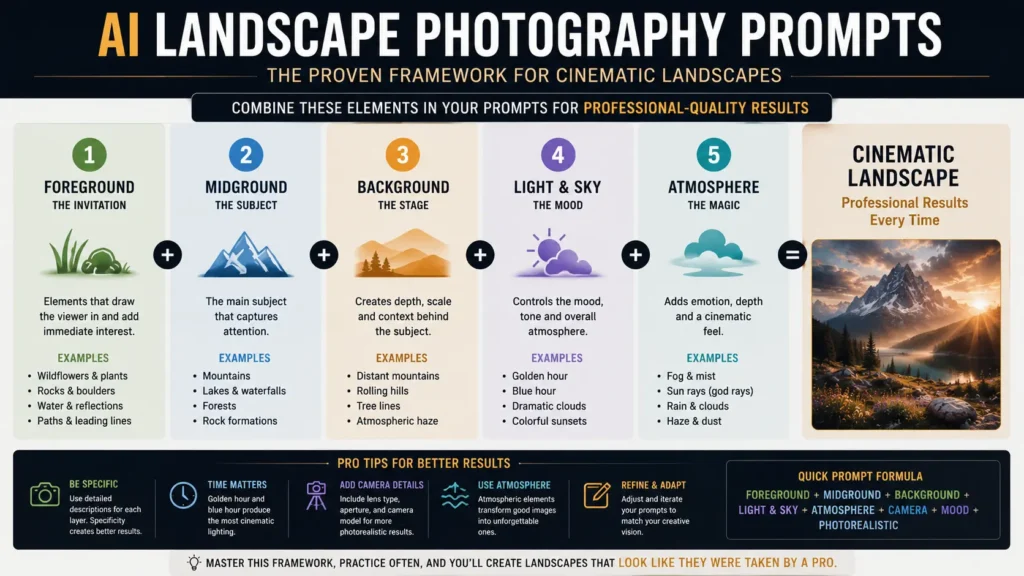
Remember the template: foreground element → midground subject → background depth → camera specs → time of day/lighting → atmospheric effect → mood → photorealism modifier.
Use this structure as your foundation. Then customize it. Swap out landscape types. Change the time of day. Add different atmospheric effects. Adjust for your target tool.
The prompts in this guide will work well. But the framework will work forever.
What’s Next? Combine This With Our Other Guides
Now that you’ve mastered landscape prompts, consider exploring:
- Lighting in AI Art: The One Prompt Skill That Changes Everything — Learn how to control light direction and mood for even more advanced results
1. Why do my landscape prompts look generic and flat?
You’re missing atmospheric effects. A “beautiful mountain” is forgettable. A “mountain emerging from morning fog with god rays breaking through” is unforgettable. Atmospheric elements—fog, mist, rain, haze, god rays—are the secret weapon. Add one atmospheric effect to every landscape prompt.
2. Should I always use golden hour light? Isn’t that overdone?
Golden hour is popular because it works reliably. But you’ll stand out more by exploring blue hour (cool, moody, cinematic), overcast light (soft, forgiving, natural), and dawn light (peaceful, clear). Try them. Compare results. You’ll find blue hour often performs better because it’s less “safe” and more visually distinctive.
3. How long should my prompts be?
For Midjourney: 150–300 words is ideal. For ChatGPT/DALL-E: 100–200 words. For Gemini and Ideogram: 100–150 words. Longer isn’t always better—what matters is specificity and detail, not word count.
4. How do I add regional elements? I want to target Indian landscapes specifically.
Replace generic landscape elements with regional ones:
1. Replace “Alpine peaks” with “Himalayan peaks”
2. Replace “Pine forest” with “Sal forest” or “Deodar forest”
3. Replace “Alpine meadow” with “Himalayan alpine meadow”
4. Replace “Desert dunes” with “Rann of Kutch” or “Thar desert”
5. Replace “Coastal rocks” with “Western Ghats rocky coast” or “Kerala backwaters”
This signals to both the AI and to search engines that your content is region-specific, which helps you rank for “Indian landscape AI prompts.”
5. How do I know if a prompt will work before I generate?
You can’t know for certain (AI is probabilistic), but good prompts share patterns: specificity (not generic), layered structure (foreground-midground-background), directional light, and atmospheric effect. If your prompt hits all four, you have a 70%+ chance of a strong result.